

Launch day! Four things for you
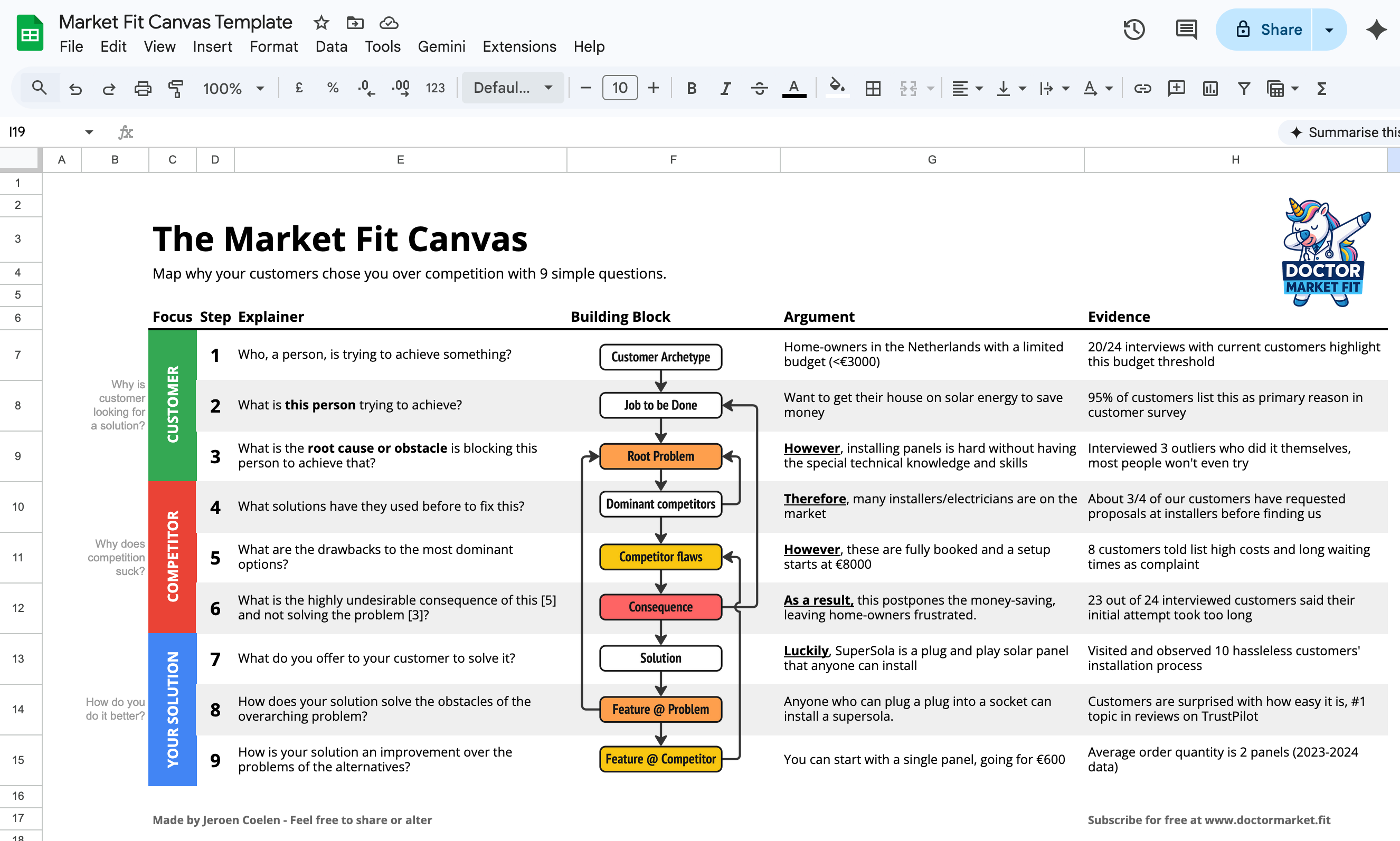
The updated Market Fit Canvas (used with over 200 startups)
A free AI tool to get feedback on your market fit
Free Google Sheet + A4 Printable Template
Instructions on how to use the framework
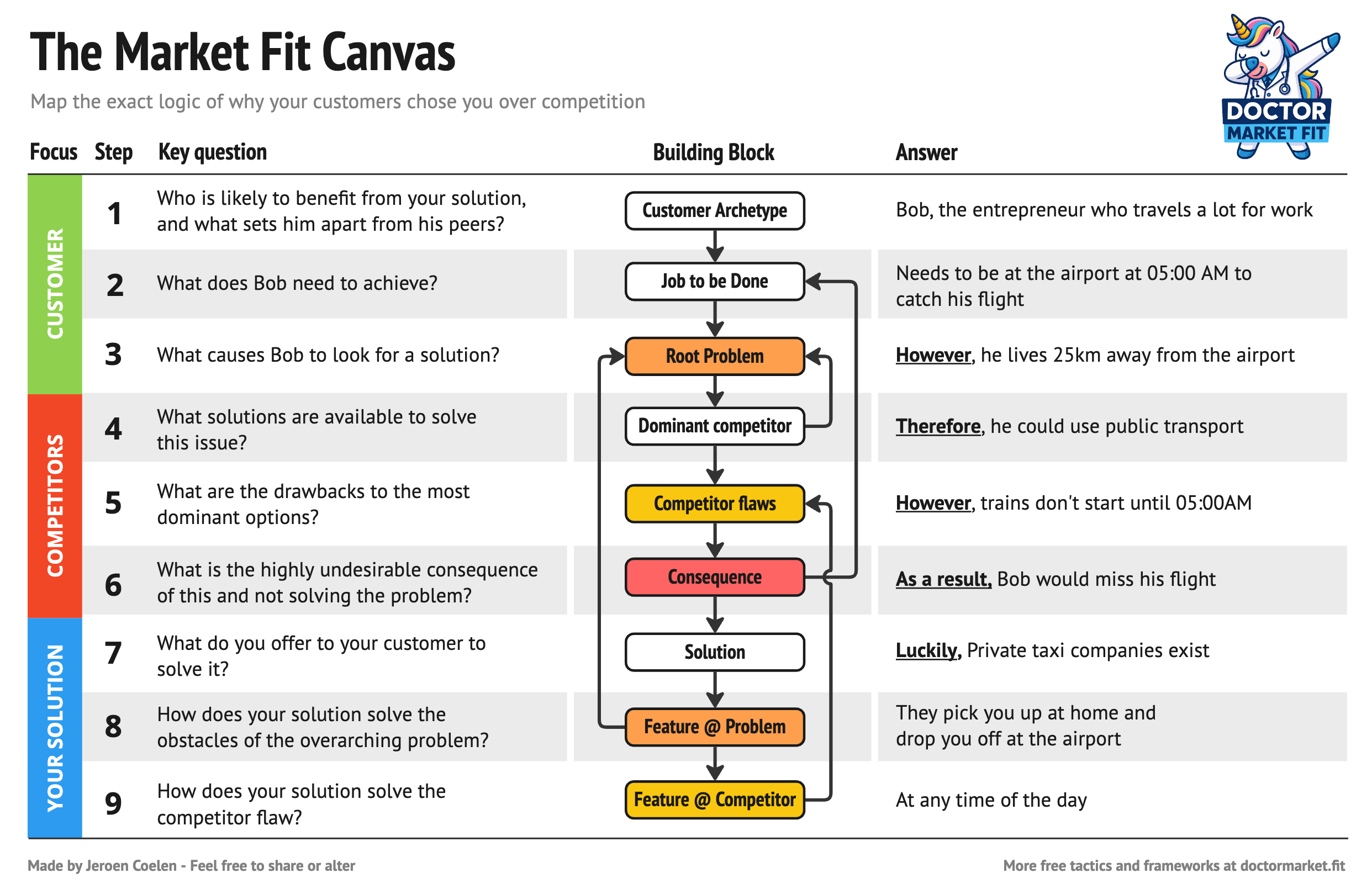
The rationale
Founders should be able to answer three questions:
Why is the customer in the market for a solution in the first place?
Why are the current alternatives on the market not good enough?
How is your solution better?
This gives three focal areas, which the above framework addresses.
Customer
Competitors
Your solution
Market Fit Feedback Tool
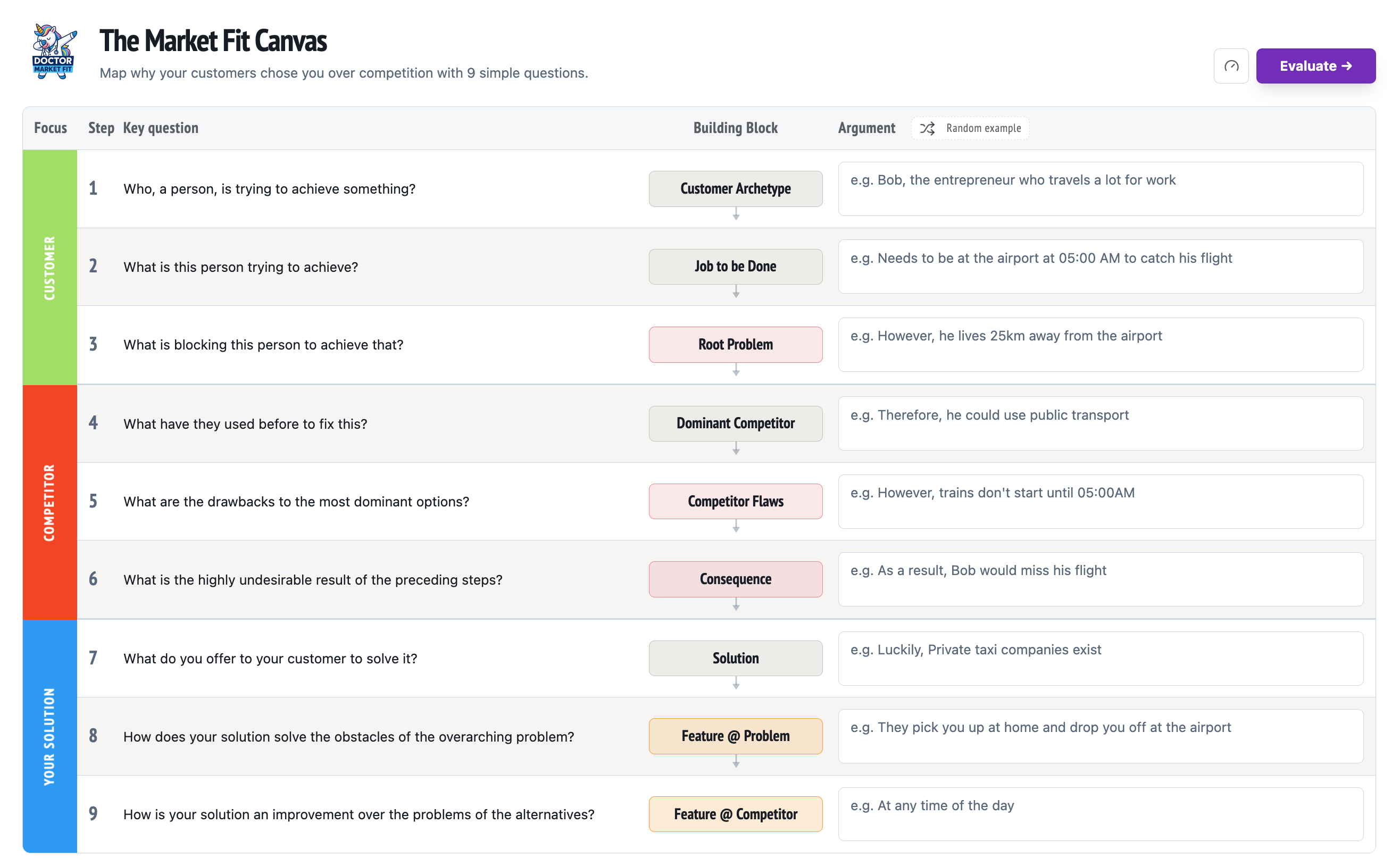
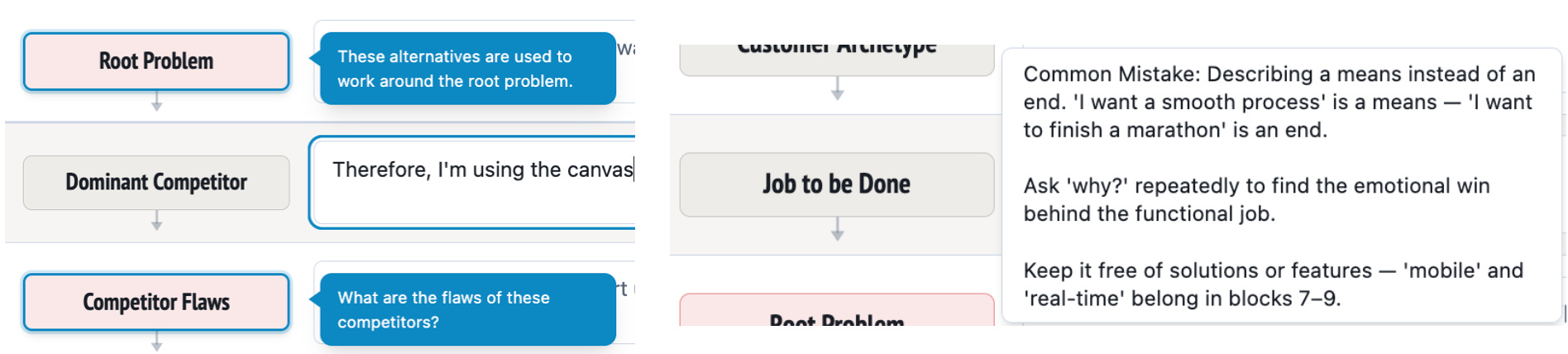
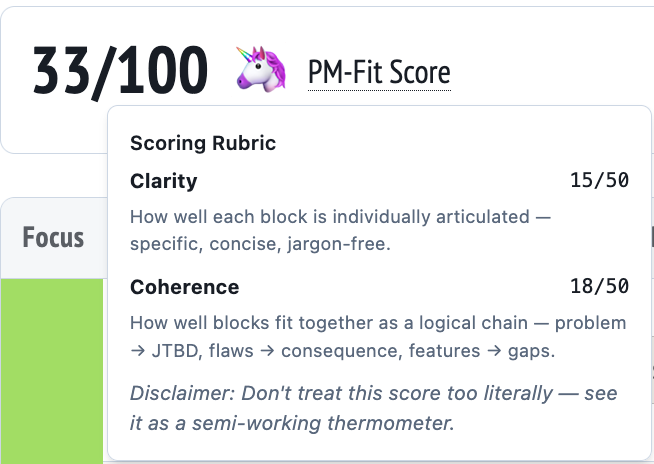
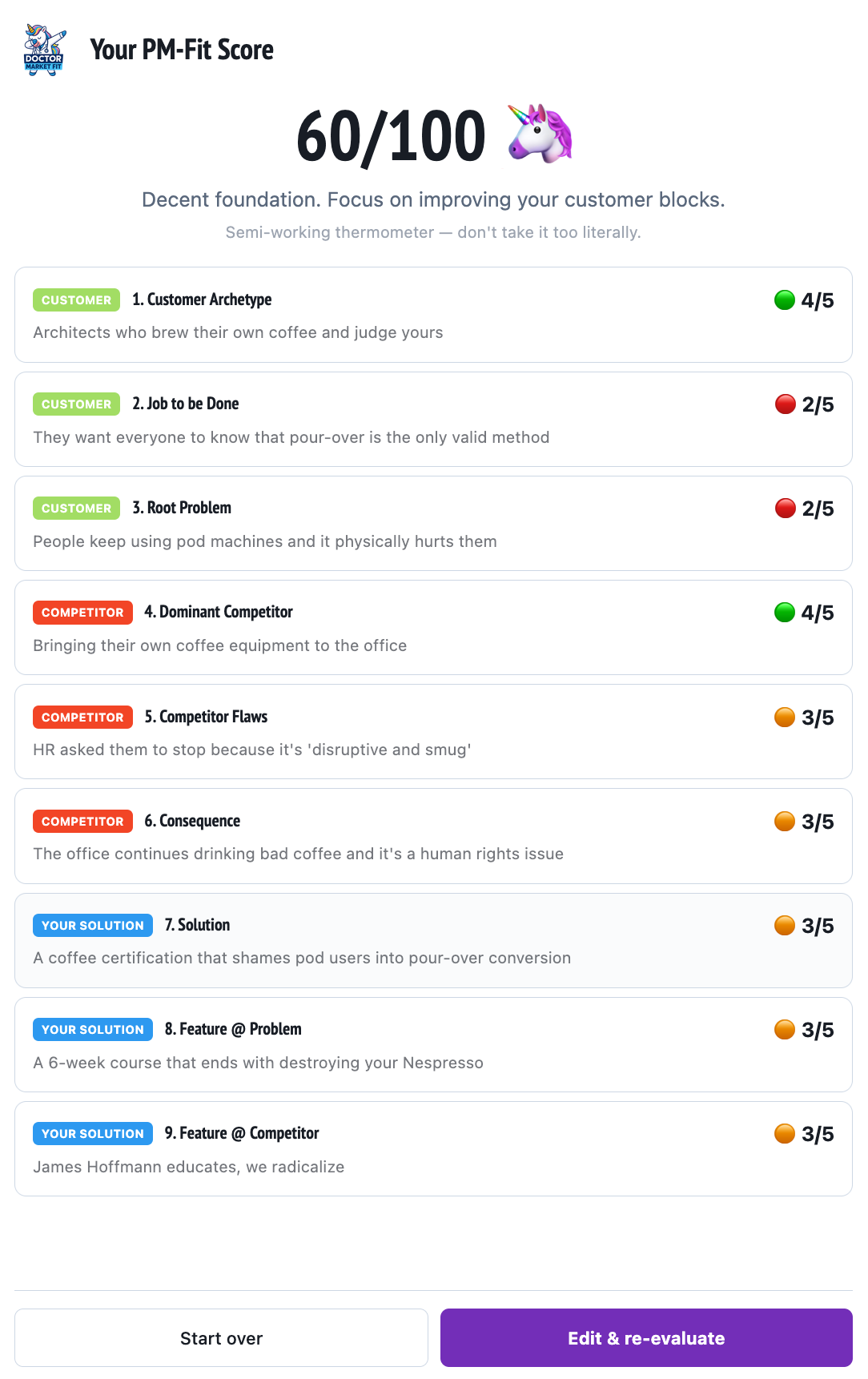
To use the framework, I’ve made a web app that gives feedback and a 0/100 score. Some screenshots below.
Explanatory tooltips that help with your input
Get overarching score
Feedback per building block

Optimised for desktop, but works on mobile
Free Templates
Digital
If you want to save your work to share with yur team, you can use this template.
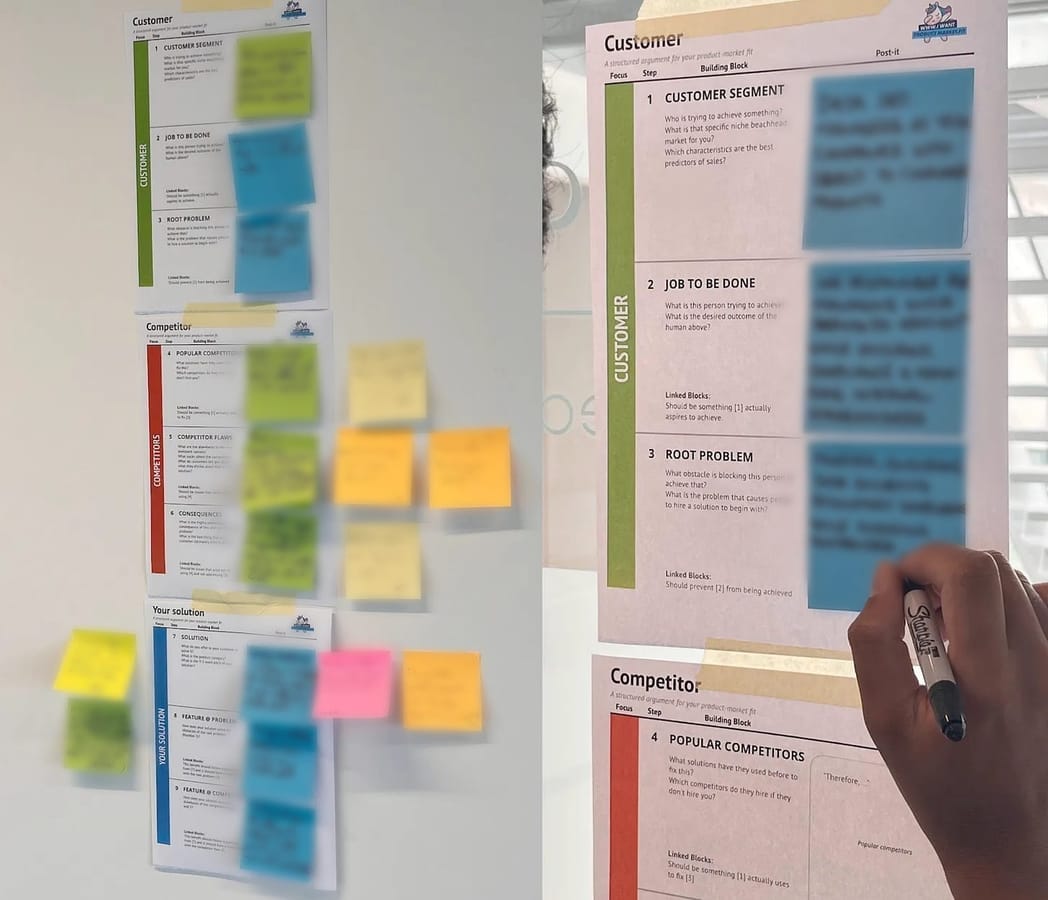
Printable worksheet for workshops
A post-it optimised worksheet! Print on A4, regular post-its fit in the box. Grab those post-its and run a Market Fit Workshop yourself.

How to use
Likely, you will have multiple answers per building block. The goal is to make single narratives that fit together well. This might mean you can make 4 different stories for each customer segment.
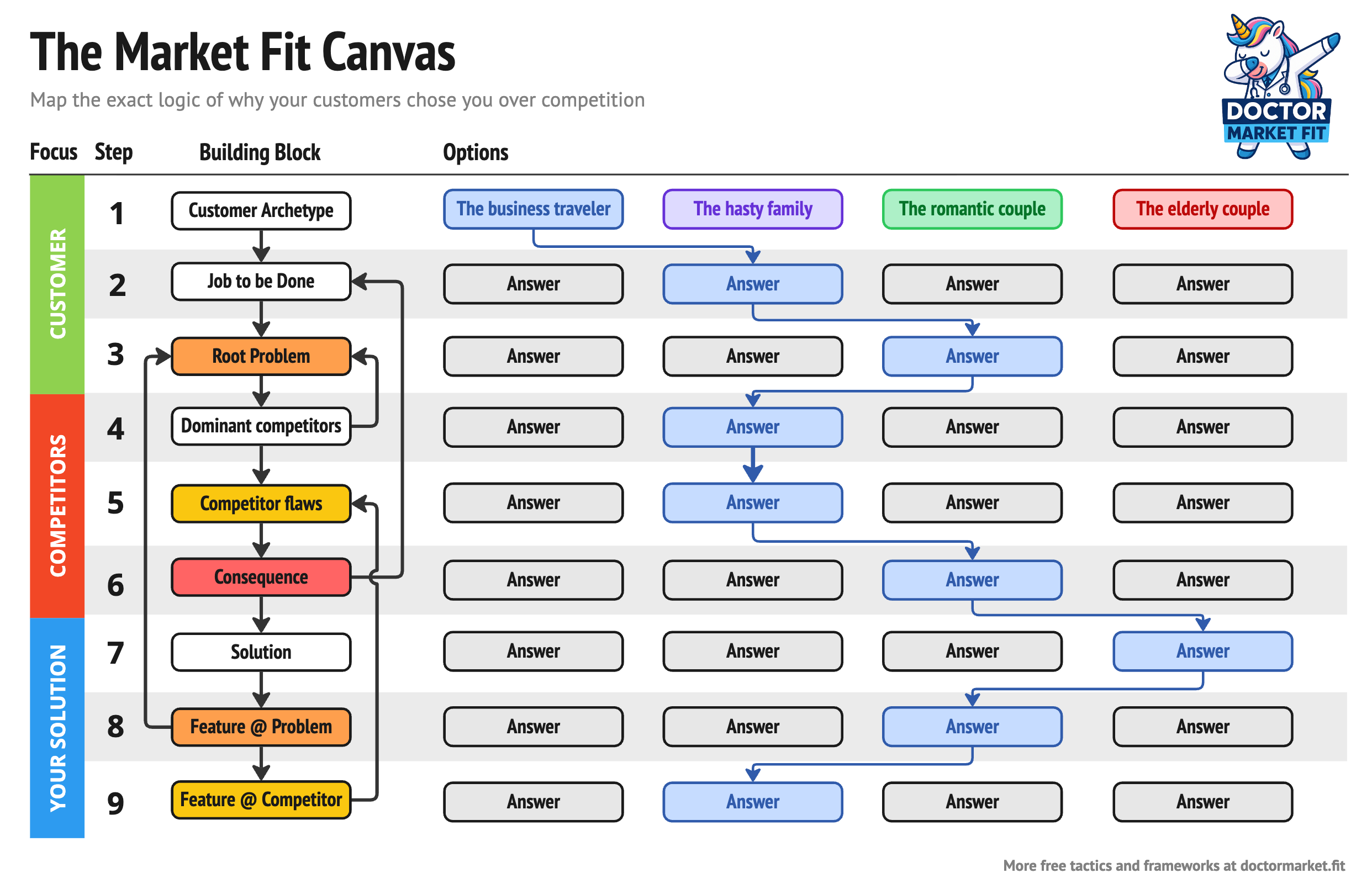
For instance, for the ‘hasty family’, these could be the answers.
Customer Archetype: Hasty Family
Job to be Done: Get to the airport complete (with everyone and everything).
Root Problem: However, they have three young kids, six suitcases, and are leaving during the morning chaos.
Dominant Competitor: Therefore, they could drive their own large SUV and park it in long-term storage.
Competitor Flaws: However, loading the car is a “Tetris” nightmare; the parking shuttle is slow and hard to manage with strollers/heavy bags.
Consequence: As a result, they arrive at the gate exhausted, sweaty, and realise they forgot the toddler’s favourite toy in the trunk of their car 5 miles away.
Solution: Luckily, there’s a “Full-Service Family Van” transport.
Feature @ Problem: They provide an extra-large vehicle with pre-installed car kid seats; the driver assists with a “final check” list.
Feature @ Competitor: Curbside drop-off that handles luggage directly to a porter, skipping the parking shuttle entirely.
Customer (1-2-3)
In steps 1, 2, and 3 you need to lay out the situation of the customer.
Customer Segment: Who is this, specifically?
Which beachhead customer segment are you talking about?
Make it a real person, so ‘Head of HR’ instead of ‘HR Department’
Job to be done: What is this person trying to achieve?
What is their Job to be Done?
This is not your or your startup’s job to be done!
Problem: What obstacle stands in the way of achieving that Job to be Done?
Understand that a problem and a job is not the same thing.
Competitors (4-5-6)
Here you identify that it’s not a blue ocean, and if your customer doesn’t buy you he does something else.
Dominant Competitor: What is the most dominant solution they use if they are not buying you?
Base this on customer interviews
Competitor Flaw: What are the shortcomings of this solution?
Why does it suck?
Consequence: What happens as a result of the current best option and not fixing the underlying problem?
This must be something people really want to prevent from happening. It should be painful, such as ‘wasting €10k a day’ or ‘employees get fired’
Your solution (7-8-9)
Only now can you start yapping about yourself. But, if you crafted step 1-6 well, your solution should fit like a glove to the problem you just sketched.
Solution: Pitch your solution in 1 sentence.
Explain the product category. What is it that you make
Benefit A: Explain how your solution fixes the problem
Make sure your benefit actually tackles the problem of step 3
Benefit B: Explain how your solution addresses the shortcomings of alternatives
Make sure that the problem you framed around the shortcomings of the alternatives (step 5) fits really well with this benefit
Want one-on-one personal guidance? Book a free intro call with me. Pricing and link below.


