


In a provocative essay, investor Jerry Neumann claims that the popular startup methods don’t work
Lean Startup, Mom-Test, the Business Model Canvas, or accelerators simply don’t move the needle
While his arguments are flawed, I agree with his diagnosis
As a solution, he’s looking for a true science of entrepreneurship
He wants a systematic method to generate competitive startups for everyone, increasing the survival rate.
However, he’s asking for the impossible and missing the reason why
He’s looking for laws of physics, but startups are not natural phenomena
I’m Jeroen Coelen, a PhD candidate on early-stage startups, entrepreneurship and design. As an ex-founder and startup advisor, I’ve mentored over 350 startups towards product-market fit.
First and foremost, I completely agree with the conclusion of Neumann’s piece: these methods are not the silver bullets they claim to be. However, if we are going to properly diagnose the problem, we must arrive at that conclusion the right way. Neumann’s argument relies on three distinct evidentiary flaws.
First, in the viral essay, he shows a graph of the startup survival rate of the past 30 years: a daunting flat line. His conclusion: the methods don’t work. However, he knowingly cites data that includes all new businesses, not just startups. The critiqued methods, like Lean Startup or Mom-test, are not aimed at restaurants or hairdressers. That dataset is too broad to prove the point.
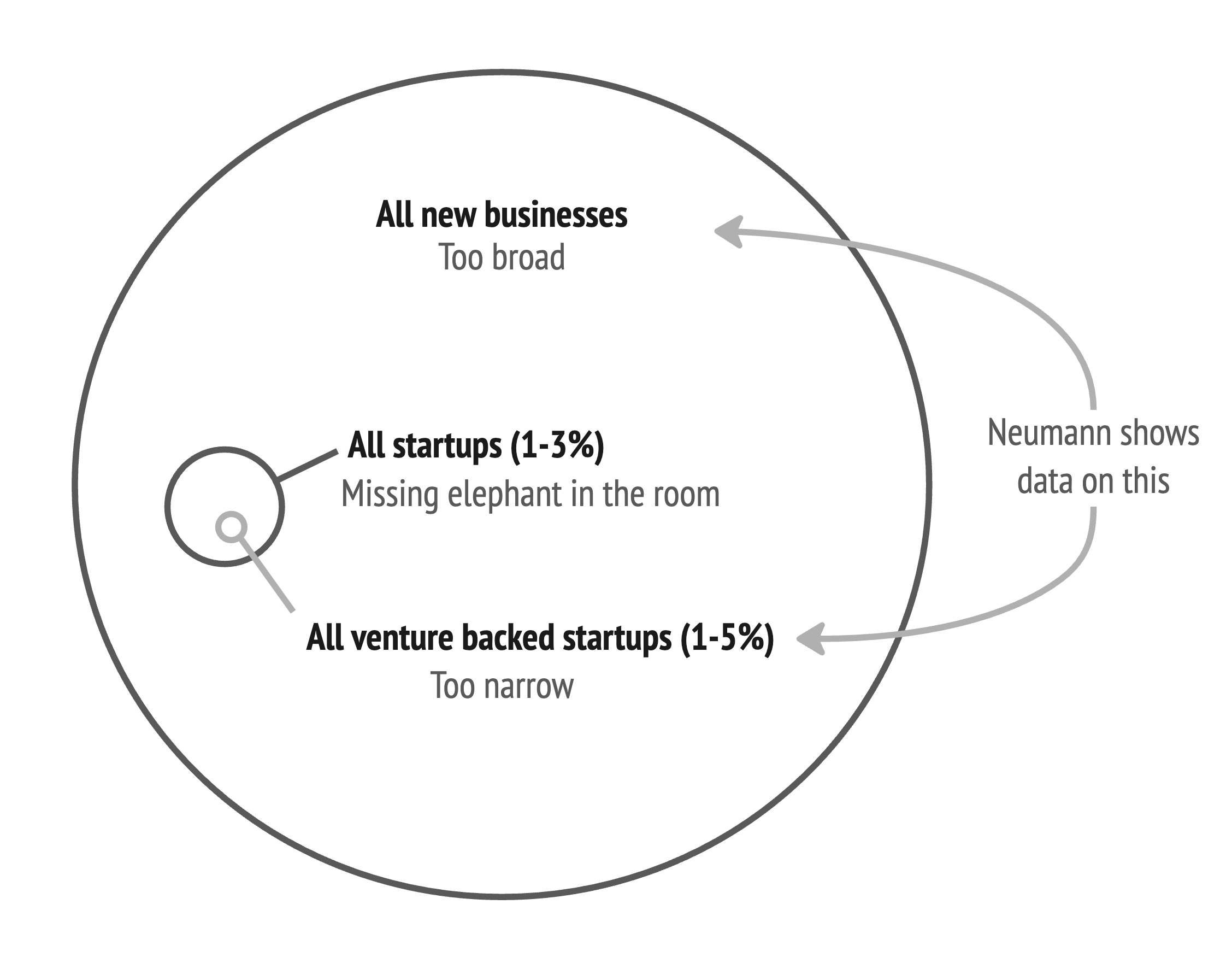
Second, in another graph that doesn’t show improvement in startup performance, he cites data only from venture-backed startups. This excludes the many startups that have never received funding, which some estimates place at 95% off all startups. Think of the bootstrapped startups, built in attics for 2 years and abandoned after only finding 5 customers. Summarising, Neumann’s selected evidence is either too narrow or too broad to prove his point. I’ve detailed a breakdown of the flaws in these number in Appendix A.
The patient skips the snake oil
Third, perhaps the simplest argument why the overall startup survival rate isn’t going up—a point Neumann seems to miss—is that most founders in the trenches actually don’t use these methods. Studies show that perhaps most startups just once used a business model canvas as part of an accelerator program, but the vast majority (90%) of startups don’t use risky assumptions, to name one. To make a dent across the line, the lion's share should deploy the method. The fact that a million books are sold doesn’t mean they are read, let alone applied well. Simply put, if the patients don’t take the medicine and remain ill, we can’t blame the medicine (see Appendix B for a breakdown with sources of this).
Still, even if adoption were perfect, I agree with Neumann that the effects are quite limited, or entirely non-existent for many methods. There are many scientific studies into entrepreneurial interventions, including methods, accelerators, and university courses, that either have no results or, at best, produce unreliable hits and misses. That’s a red flag for sure. Overall, the startup medicine is not working well (see Appendix C for specific studies).
If the medicine isn’t working, it’s helpful to see who the pharmacist is, as these methods originate from two distinct camps with very different goals.
Who is the pharmacist?
Neumann rightly shows that all of the pundit’s methods emerge in response to the strict managerial approaches aimed at larger enterprises. Startups indeed require different playbooks, which, if we zoom out, can be classified into two groups: those made by practitioners or by scientists.
Take Ries and Sarasvathy as archetypes. Eric Ries, author of Lean Startup, is a practitioner who has, in his work, developed a scientific method-inspired approach to startups. He writes a book about that method, and it becomes a hit. Many such practitioner-written books exist: Mom Test (Fitzpatrick), Build (Fadel), and Four Steps to Epiphany (Blank). They are valuable in their own right, but differ from people like Sarasvathy.
Saras Sarasvathy is a scientist interested in entrepreneurship. She is one of the biggest names in the academic field of entrepreneurship; I doubt I have ever met a fellow scholar who doesn’t know her work. The basic premise of Sarasvathy’s work is that entrepreneurs don’t reason backwards, i.e. to determine the means to acquire from a clearly defined outcome. Instead, entrepreneurs have a vague idea of what they want, and based on their available means, make a plan for the near future. Effectual logic, she dubbed it. Large studies have demonstrated that, indeed, effectuation can yield better results, in some cases.
Overarching, the origin of these two methods is distinctive. Effectuation stems from science, which describes how successful entrepreneurs launch ventures. Lean Startup comes from a practitioner who suggests a novel approach: n=1 versus n=many. This gives us two camps, summarised as the practitioners and the scientists.
Practitioners, who make frameworks and methods from their own experience
Example: Lean Startup, Mom Test, Four Steps to Epiphany, for instance
Scientists who produce actual science on the phenomenon of entrepreneurship
Example: Sarasvathy, Porter, Schumpeter
Still, neither of these methods is a silver bullet, and Neumann analogously invites medicine and botany, two academic disciplines which have had demonstrable success on society. Why don’t we have that for entrepreneurship? Simple answer, we haven’t been at it nearly long enough.
Entrepreneurship research is very young
Entrepreneurs have been around since about 10.000BC. For instance, with the Mesopotamians, who strategically farmed particular onions for selling, or ancient Greek sea merchants who would travel overseas on lucrative trades.
However, it is ‘only’ since the 18th century that entrepreneurs emerged as a subject of scientists. After the feudal system fell throughout Europe, the emerging capitalist economies prompted scholars to understand market behaviour. However, it took a little detour for what successful entrepreneurs do to become a dominant line of inquiry.
The economists wanted to understand where profits come from: some people can sell products above their costs. Those people were entrepreneurs: risk takers who speculated about buying something in the hopes their selling price would be higher. Others, like Schumpeter, explained that entrepreneurs are innovative and therefore can charge more. But, how the entrepreneur did exactly that was not in focus; the economists who described them were interested in market behaviour, not entrepreneurial behaviour.
The entrepreneurs themselves became a focal subject for psychologists after WWII, as policymakers were interested in identifying them among a general audience to rebuild a torn Europe. They found they were innovative, and some had a higher risk appetite. But what successful entrepreneurs actually did, actions which ought to be copied, remained largely out of focus until the 1980s and 1990s, when entrepreneurship became a scientific discipline of its own.
Today, it’s completely normal to have a ‘Professor of Entrepreneurship’, whereas in the 1920s, such a title would be very unlikely—some pinpoint the first ones to the 1980s. Increasingly, instead of explaining the market or the person, the actions of the entrepreneur appeared to be the most interesting bit to researchers; a realisation that swept through the field around the 1990s. Additionally, with the rise of entrepreneurship programs at universities, academia became increasingly concerned with more practical approaches to teaching entrepreneurship.
And thus, even though entrepreneurship has been a human practice for millennia, serious attention has been given to the development of better methods for only a few decades. Therefore, one could consider these books and methods perhaps the fledgling first results of decades of research and rising practitioner interest in the matter.
If one counters this by saying, “But computer science and engineering studies are relatively young too, and they have measurable results”, I need to acknowledge the effects. However, these disciplines have very strong roots in mathematics and physics, two disciplines which are millennia old. Entrepreneurship doesn’t have such a foundational theory. But even if they had one, scientists struggle with another aspect.
Getting your medicine to market
In this young and emerging field of entrepreneurial tools, many people have ideas of what good entrepreneurial approaches are. But not all ideas reach the masses. Whereas Lean Startup was popularised by Eric Ries since 2011, the idea of entrepreneurs as scientists has already persisted in the entrepreneurship field since at least 2009 (Felin & Zenger, proponents of the idea ever since). By 2012, that original paper had about 50 citations, whereas Ries’ book was nearing 100.000 copies sold.
While there are academic critiques of the scientific backing of Lean Startup (published in 2018), including the lack of empirical evidence for the method, the idea has found its way into many heads, and is perhaps one of the most well-known methods, getting global recognition in the previous decade.
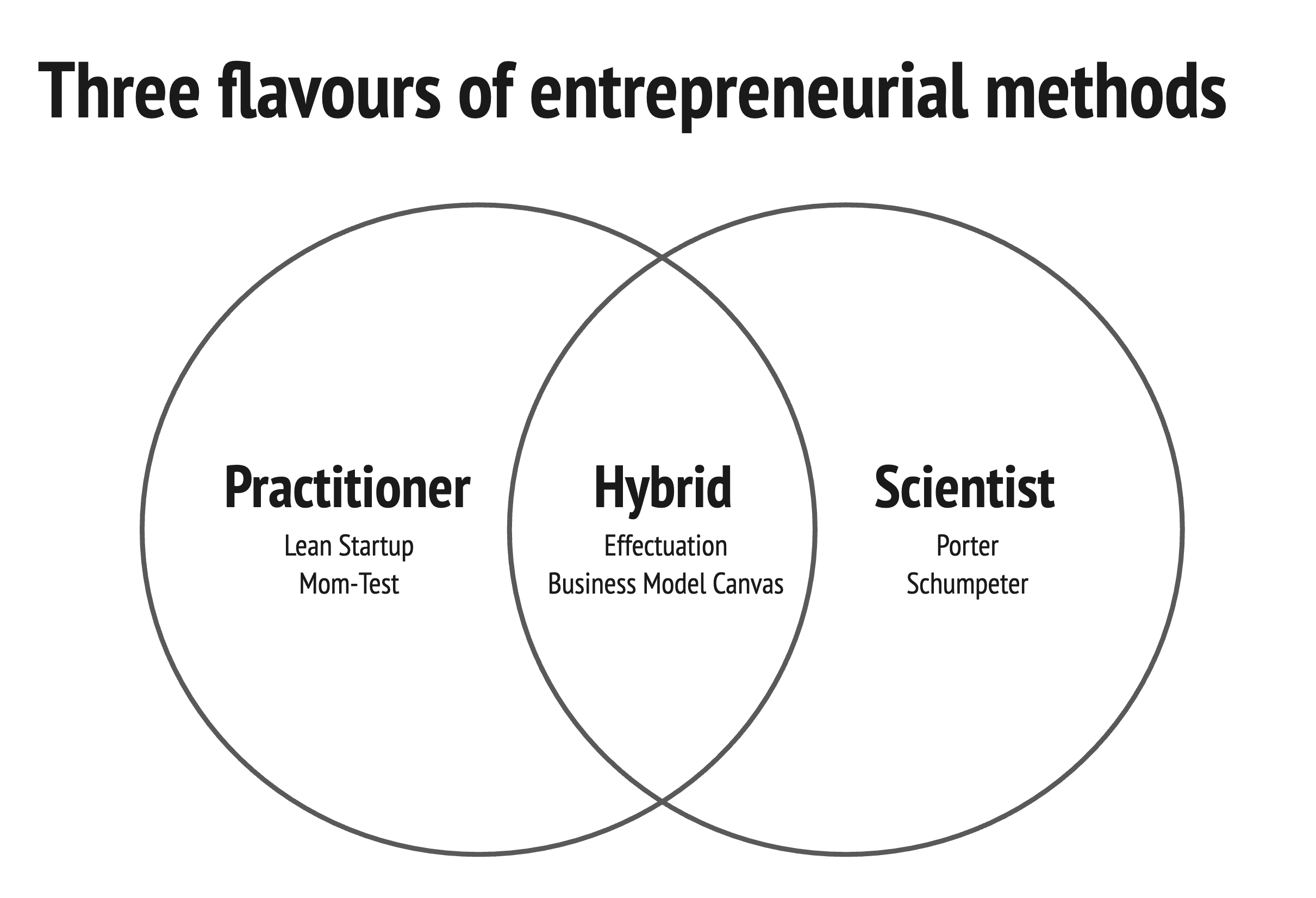
In contrast, there are some ideas that remain quite esoteric: Schumpeter’s writings on creative destruction or Porter’s way of looking at markets have remained dominantly in the scholarly realm. An interesting middle form is the hybrid. Ideas that have an origin in science, but have been transposed to make them accessible.
The Business Model Canvas is a great example of this. The original research was a PhD by Alexander Osterwalder, but a Dutch company contracted Osterwalder to make a practitioner book about it, and sold millions. Similarly, Sarasvathy’s effectuation has been transposed into books that a founder actually may want to read.
Great ideas without an audience are useless. Yet, it may be striking, but many scientists in the field of entrepreneurship are not hugely concerned with the direct applicability of their findings. Sure, they see it ultimately might contribute, but I used the word direct here carefully.
This tendency, ironically, has been well described by scientists as resulting in the theory-practice gap. It boils down to two issues: what interests the academic might not be of interest to the entrepreneur. A theoretical discussion on the right definition of a startup might not be helpful to a founder who is trying to find product-market fit.
Furthermore, that gap is even broader because founders barely read papers, so even if the right topics were addressed, the medium is a problem too, which again, scholars realise. That is the reason I started this Substack at the start of my PhD: to have at least an outlet towards people in the trenches, which keeps me on my toes. But even if we make a superior theory, according to Neumann, it comes with a caveat.
Looking in the wrong place
If a method reaches the masses and when they would apply it effectively, everyone gets the same competitive advantage. Neumann calls this the Red Queen fallacy. If everyone gets the medicine, the virus will adapt: running faster just to keep the same place. Therefore, he is asking for a better meta-method:
that can meet scientific standards,
is capable of producing competitive advantages,
is available to everyone,
yet, won’t deplete these competitive advantages.
This seems paradoxical. If everyone has access to a competitive edge, it will surely eradicate itself. While he acknowledges that he’s not looking for another 26-step framework—Sorry, Bill Aulet—he’s looking for a meta-theory for generating startups or new methods for startups. Here, he draws heavily from the natural sciences, with evidence-based falsifiable theories, citing Popper. The good thing is, I believe there already is such a thing, yet Neumann is looking in completely the wrong direction, as in that section of his essay, he invokes a fatal flaw.
Indeed, Neumann rightfully assesses that there are many paradigms in entrepreneurship research. Much of entrepreneurship research is most closely related to a social science, as it describes people. Within such sciences, there are many ways to look at the world: we can explain people’s behaviour through a lens of group dynamics, cognition, and neurology, to name a few. Neither of these paradigms is right or wrong; it ultimately depends on the question you are after.
But what all these paradigms have in common is that they are trying to find the regularities in the way the world currently works. This is perhaps best described by Herbert Simon, Nobel Prize laureate. He made a case for that, describing how a tree forms or how a table comes about are two very different things. In one, a human acts to realise his mental state to create something that doesn’t exist in nature by itself; in another, a biological mechanism takes place. He contrasts the necessary, guided by natural laws, with the contingent, guided by human intention.
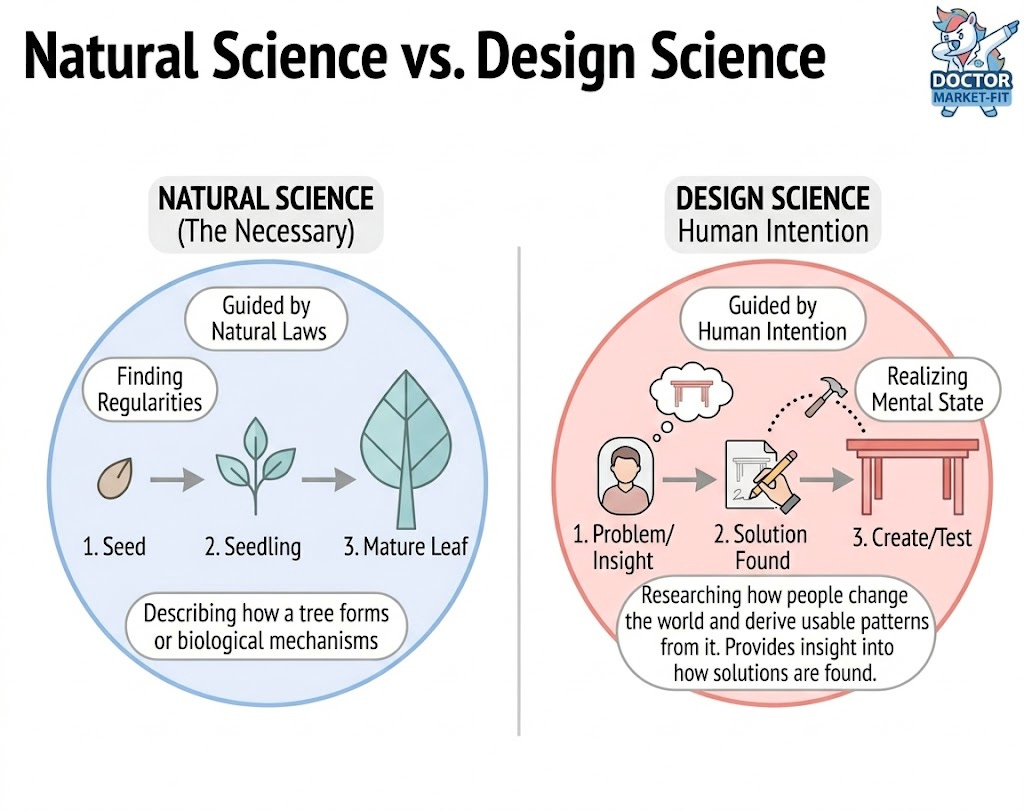
Simon says: there’s science about the natural, and there’s science of the artificial. The latter is called Design Science—which, contrary to what Neumann claims, is not to be seen as the precursor of Design Thinking, but that’s a different essay.
Design science can be viewed as an approach to researching how people change the world and derive usable patterns from it. Design science complements the scientific method, as it provides insight into how solutions are found. In that scientific domain of design research, advancements have been made since the 1950s that have reached a broader audience.
Entrepreneurship as a craft, founders as architects
Neumann says he’s looking for better theories of entrepreneurship, but focuses on the wrong paradigm that describes the world. Design science has answers, and an increasing number of entrepreneurship researchers are adopting a design perspective to understand how entrepreneurs actually do their work.
In this perspective, entrepreneurs are not scientists; they are architects. That analogy helps to explain why it’s so hard to make a silver bullet for startups. There’s designing a building, and proving the building. Is there a method that helps architects design beautiful buildings? Not really. Formalised numeric theories of beauty? Not really. Are there common rules of thumb that help young architects learn what works and doesn’t, aesthetically? Sure. Are they sometimes taught to break the rules? Very often.
Engineers can prove the building stays erect. There are engineering theories that help to calculate if the building will stay up. An architect has the luxury of being safely anchored by such quite objective physics. For startups, however, this is more than a bit trickier. Can you calculate if a startup idea will work?
We haven’t discovered such a full-fledged formalised physics of startups yet (We are waiting for it, Rob Snyder!). There is no underlying 'startup physics', no immutable natural laws like gravity or material strength, to mathematically prove a business model won't collapse. I wonder if it ever will be possible.
Crafting a better medicine
Neumann is right, the current medicine isn’t working. But that is because he expects startup methods to act like natural laws. In design science, there are no magic pills. Only better tools, and learning the craft to use them.
Everyone will appreciate that there’s an intuitive and subjective aspect to architecture. Such knowledge is hard to codify, and the education of architects has aligned with such a knowledge base. Architecture school is five years of studio work with designing many, many buildings to learn the craft. Often, many years of actual professional work are required to become great.
The same goes for doctors. They study for 5 to 10 years, and a big part of that education is being an apprentice doctor at a hospital. In the meantime, they get information about the latest theories and insights about novel diseases and treatments, but the medical profession recognises that learning to apply such insights is a skill in itself: a craft.
VCs asking for scalable, proven methods seem to ignore that entrepreneurship is also such a craft: a discipline requiring deep insight into the underlying mechanisms, which can mostly be obtained through experience.
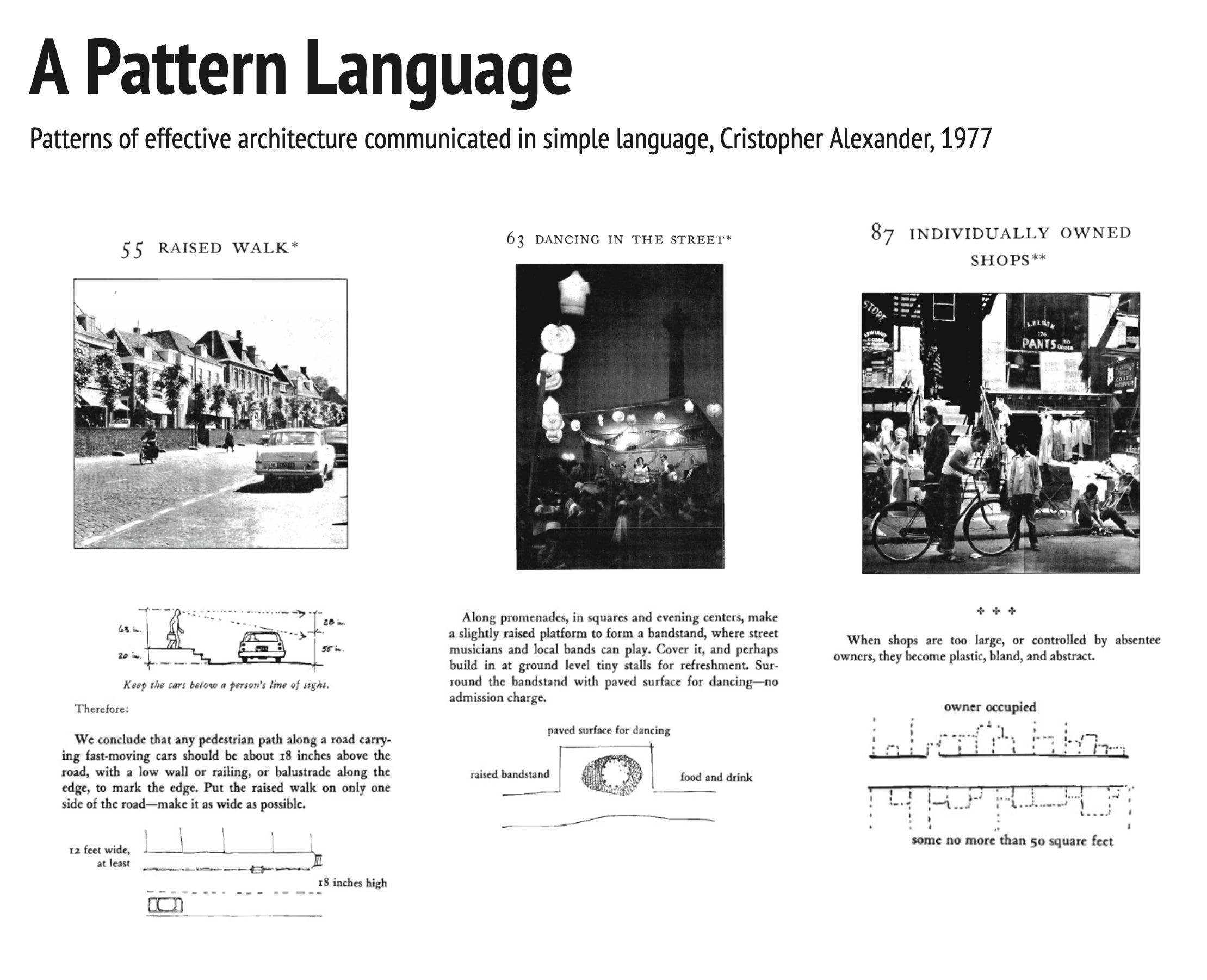
But while we cannot codify a founder’s intuition, we can codify the essential principles they use. Design research allows for contingency and recognises regularities, without pretending there are full-blown natural laws. For example, Christopher Alexander, architect and researcher, has developed ‘A Pattern Language’, an accessible book of design patterns that work, a classic at architecture institutions.
Robust pattern finding
I imagine the future for startup methods is the development of such patterns. The patterns are building blocks that entrepreneurs can use in their own synthesis: making new competitive startups, but with a unique personal aspect.
One might argue that this sounds a lot like what the Business Model Canvas does. And indeed, the BMC was generated exactly using a design science approach to discover regularities. The fault was to treat this heuristic as a rigorous method. The BMC doesn’t tell you when you’ve filled it out correctly; anyone can give 9 answers, but only seasoned founders or workshoppers can evaluate it well. It is a sign of an early theory: getting abstract frameworks right, but not yet operationalised to the full details.
I foresee future research revealing very concrete patterns, such as: “This is what good product-market fit looks like in med-tech, with six distinct examples” or “These are the two dominant revenue models for aerospace polymers”. It would be a true catalogue, much like A Pattern Language. Right now, we rely on expert practitioners to intuitively spot these regularities in the wild. For instance, Rob Snyder has done excellent work uncovering the raw patterns of market demand and pull.
To advance these practice-rooted insights, I believe scholars must play a crucial role in making these principles testable and robust. In my PhD, I’m attempting such granular codification: translating advanced insights on product-market fit into simple, actionable tools for founders. When that is finished, I hope it proves the value of bridging rigorous theory and founder-led practice.
With entrepreneurship emerging as an academic Design Science where such principles are commonplace, the next three decades hold massive potential for making a real dent in the startup survival rate.
Appendices & References
Appendix A: Too narrow, too broad
In the essay, Neumann frames ‘the pundits’: the books, programs, methods, frameworks that everyone in startup land uses. The issue: no impact whatsoever.
The lack of effect is illustrated via two graphs. The first graph—which has gone viral on LinkedIn—shows the mostly constant multi-year survival rates. It is based on data from the US Bureau of Labour Statistics, and such numbers are trustworthy. Yet, there’s a caveat.
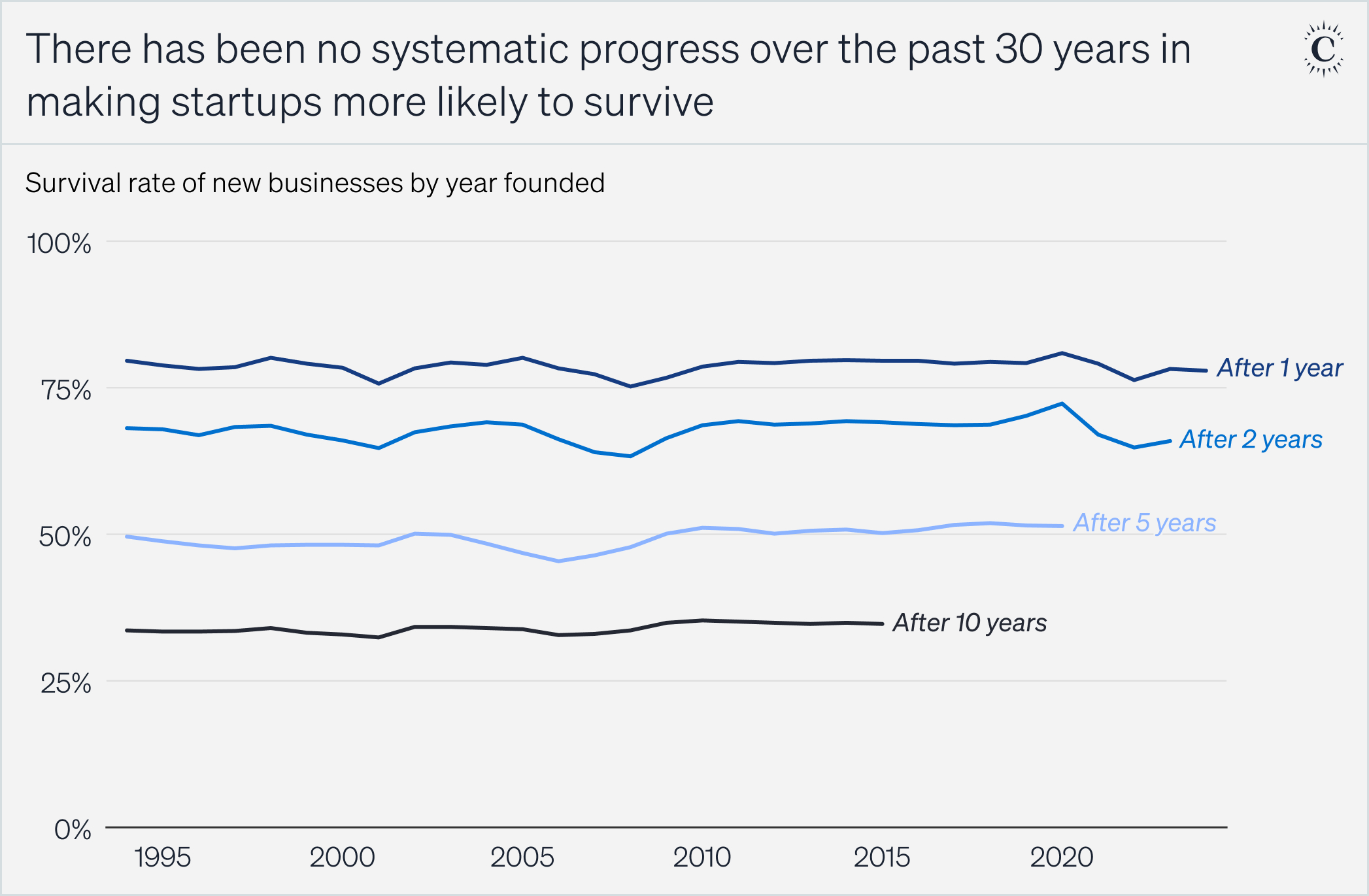
That dataset is about all new businesses in the US, not just startups. A startup is commonly defined as an emerging organisation in search of a repeatable, (highly) scalable, innovative business model.
Therefore, a new hairdresser or a freelance carpenter doesn’t fit that bill—About 80% of those businesses are sole proprietors, for that matter. Likely, most of these entrepreneurs don’t read Lean Startup, follow Design Thinking; that local carpenter probably doesn’t get into YCombinator (would be cool if they did, though).
Estimates are hard, but being generous, only ±3%1 of all new businesses fit the startup label. Even if startup methods were 100% effective, the impact would not be noticeable in that diagram, as fluctuations of the past have been higher than the share of startups. Thus, the above graph is not capable of proving Neumann’s thesis.
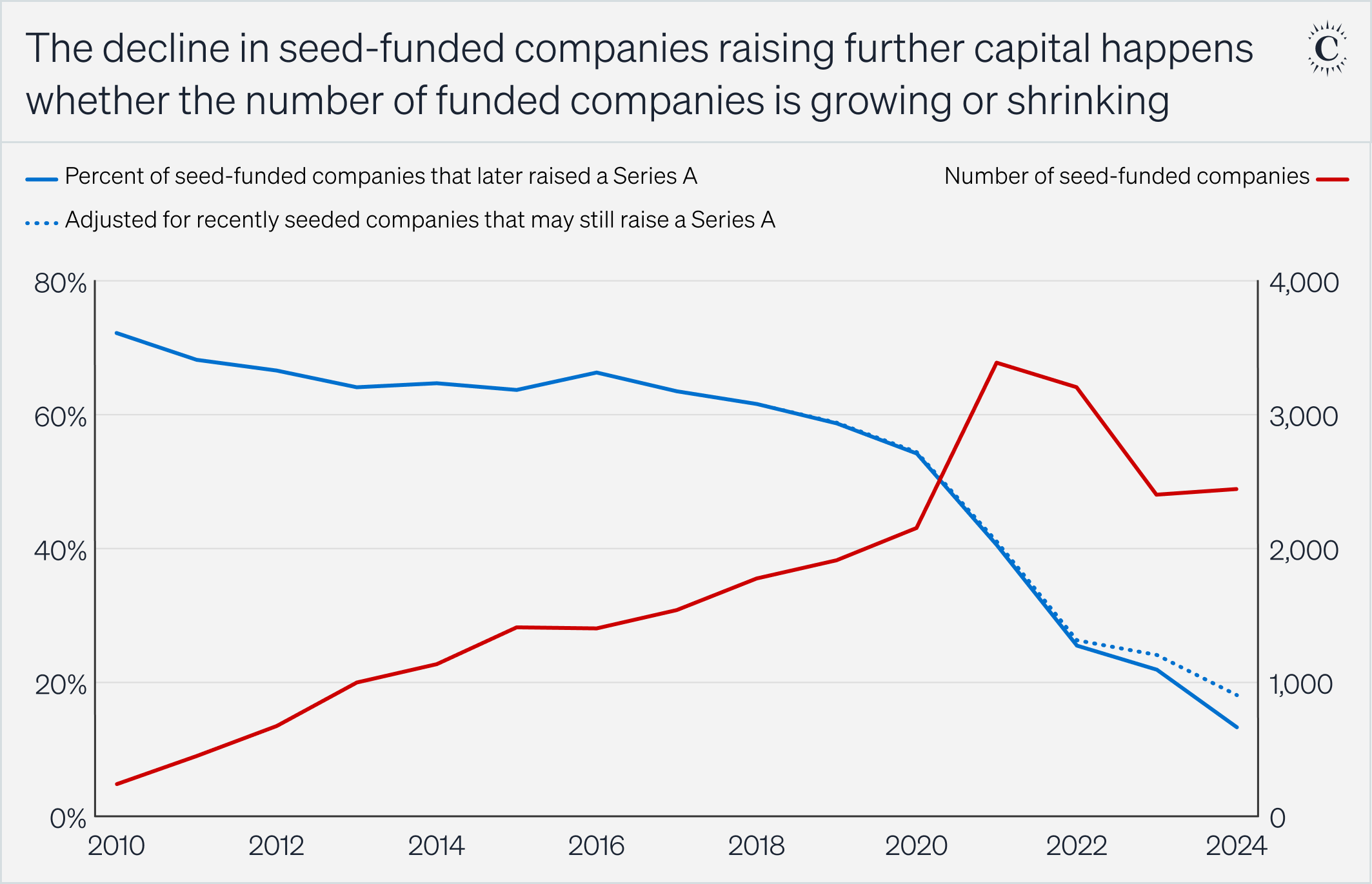
Additionally, in a different diagram, Neumann shows how the rate of ‘startups raising subsequent rounds’ is declining. Yet, to me, it’s not too clear why that can’t be explained by other factors than ineffective approaches (see caption). Furthermore, only about 1% (hard estimate to verify) of startups raise investment, leaving out 99% of the startup population. My conclusion: both graphs are insufficient to prove the methods aren’t working.
Appendix B: Entrepreneurs in the wild don’t actually use them
Actual entrepreneurs in the trenches don’t follow the methods. Yes, some accelerator programs will use Disciplined Entrepreneurship by Bill Aulet. But, for instance, a survey among hundreds of startups in Italy showed that only 11% use systematic hypothesis testing:
“Among the lean concepts, falsifiable hypotheses were the least used” - Ghezzi, 2019
The most popular tool was the Business Model Canvas, seemingly because the accelerator forced them to use it in a workshop. A graduate student of mine interviewed a set of founders, discovering a similar pattern: such methods were once provided during workshops, but in the day-to-day of their business, are not used.
I’ve worked with hundreds of startups, and very few work with such methods systematically, especially outside of accelerators. Some will do sprints or scrum for software development, but that’s about it.
What about the books?
Oh yeah, the books. Everyone knows the Mom-test, but do they read it in full? Well, a brief survey among my followers revealed that indeed some books are classics.
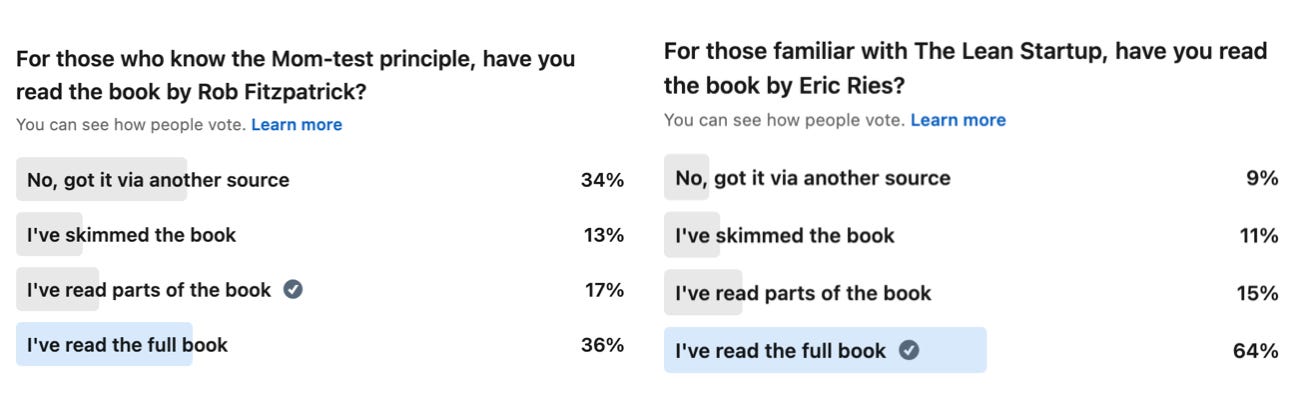
But, this sample surely is biased: who would admit they didn’t read a book? I didn’t read 0 to 1 cover-to-cover, I have to admit. So books might be popular, it doesn’t tell us anything about the application of it.
In general, there’s much research that says reading can improve your professional performance, but it comes with a caveat. Knowing and doing have a demonstrated gap, and being able to transfer learning from a book to practice is estimated at 10%-20%2. So if anything, regardless of the startup world, such books and education are not a silver bullet.
Appendix C: There is more science that says ‘meh’
Instead of looking at results in one entire nation, zooming in on contexts that ringfence the methods can reveal potential effects, or the absence of it. To find the impact of interventions in entrepreneurship, it is beneficial to categorise them into three groups that Neumann talks about: accelerators, university courses, and specific methods (such as the lean startup). Luckily, each of these has had ample attention in academia for the effects, and the results are mixed.
Entrepreneurship courses at universities don’t create ventures
For courses in entrepreneurship education, it’s debatable whether they create more ventures. There’s been ample research and several meta-reviews. Some papers say there’s no (or only a very weak) effect on venture creation or performance3. There is a small effect on the self-reported intention to start a business and a person’s belief in their entrepreneurial skill. Many studies suffer a self-selection bias of students who enrol—entrepreneurial students pick such courses, so what does it prove? A large study in Denmark says it can work when taught in secondary school, with 40% increase in venture creation. I know Denmark for its hands-on way of teaching entrepreneurship, so perhaps they are onto something.
Accelerators can work, but definitely not every program.
For accelerators, there are mixed results, but most meta-reviews are positive on performance4. The type of funding, participants and design of the program have a huge influence on the effect, of course. There are many ineffective programs; sometimes this is due to the startup-accelerator fit that accelerated startups, in fact, slow down5. But, overall, some meta-reviews show that about 10-15% of venture performance can be attributed to such programs6. So, they work to some extent, but it’s not a silver bullet.
Some methods do work
Then, the techniques and methods. The list of approaches is endless, here are some tactics:
Hypotheses-based methods, such as Lean Startup: Neumann cites two studies by Camuffo et al (2020 and 2024) and states that this study only proves running your startup like a scientist influences failing fast. That is a misrepresentation of the results. The studies show effects of an increase in revenue, and startups are more likely to acquire or activate customers after a pivot: “The revenue of the treated firms grew faster than the control firms”. While significant, the difference was about 10%-20%, a big part stemming from killing 0 revenue ideas.
Open information gathering: A study shows that being open to many aspects of your customer’s life, and not only the specific data point you're after, positively affects performance.
Prioritising profitability over growth: A big study in Finland shows companies (so not just startups) that prioritise becoming profitable over growing fast have better performance (Read more)
Additional References & Footnotes
The data is hard to find, for the US it seemed somewhere around 1%. For Germany, in 2025, a number I could find was 3500, out of 650k new businesses, being 0.5%. I rounded it to 3% to be very optimistic, to show that even then, the graph doesn’t tell us anything.
Reading and its impact have proponents and attackers. Ideas such as the T-shaped professional have had widespread recognition. But this article on the knowing-doing gap is pretty convincing, too. Transferring learning from one context to another is actually pretty hard, and related to critical thinking/general intelligence. Given enough time after the intervention, the 10%-20% is accepted to be the average transfer rate after receiving training/education.
Among the studies, there are several meta-reviews that compare dozens of studies on a variety of outcomes. They are mostly from the past decade. Entrepreneurship education started to proliferate in the 1990s, but research into its effects is something of the last two decades (in my humble experience, reading about it). For venture creation effects, check out this one here, or here, or here, or here, or here. For intentions, check out this meta-review.
A 2025 study shows how health tech startups that were accepted into an accelerator underperformed those that weren’t.
The 2020 study analysed over a thousand startups across a hundred accelerators


