

To evaluate your product-market fit, you should have 10/10 market knowledge. It boils down to three simple questions:
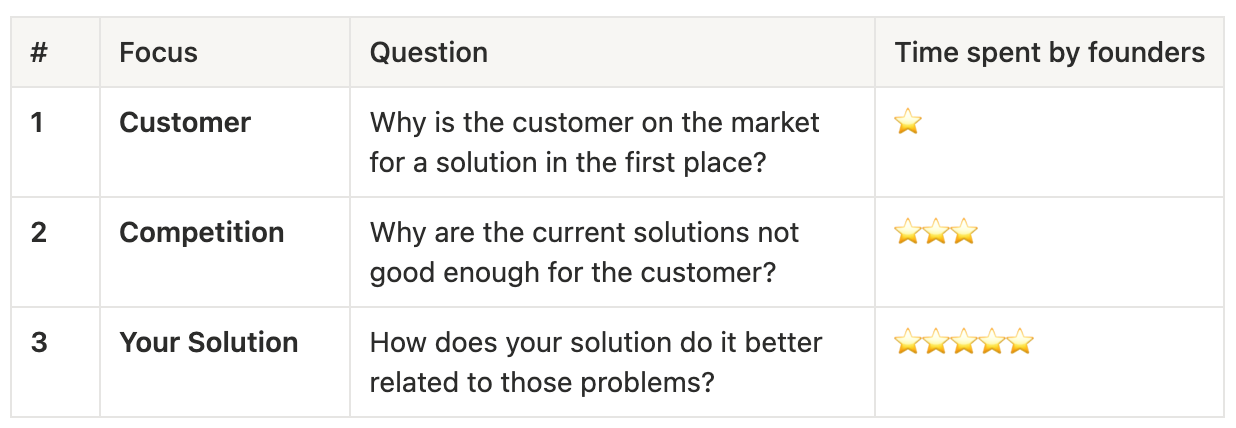
In my experience, founders spend time most time on competition and their solution, rather than understanding why they are buying in the first place.
1. Why is your potential customer on the market for a solution in the first place?
Understanding why people are on a market to buy is incredibly important. This reveals a hidden mechanism.
AirBnB: Because most people don’t have a bed and home in cities they travel to
Uber: Because they need to get from point A to point B
Notion: Because our brains are too limited to capture everything, especially in teams
The wired telephone: Because people are not in the same place
The steam engine: Because mines were flooding with water
It might feel stupid, but formulating your problem and job to be done without talking about competition is incredibly hard. Can you do it for yours?
2. Why are the current solutions not good enough for the customer?
This is where founders spend some time. They look into the market and flag features of competition. But features in itself is not enough. People should complain and bitch about.
AirBnB: Hotel rooms are often small and don’t have a nice experience of being at a home
Uber: Waiting for a cab without knowing when it comes sucks
Notion: 76 scattered Google Docs are hard to navigate
The wired telephone: Because sending letters takes 2 weeks
The steam engine: Because horses die and can’t work 24/7
Now, these complaints will differ per segment. The nature of the competition and shortcoming can be a way to segment your market.
Notion can target people that use Google Docs than teams that do everythig over Slack without proper documentation. This requires a different marketing message and perhaps channel.
3. How do you do it better?
This is what founders usually bite down on. They list how they are better, which features or benefits they have compared to competition. Applies to both hardware, medtech, and deep tech.
AirBnB: Local homes with a bed that make you feel like home
Uber: Application to order and track a cab to take you home
Notion: Interconnected and dynamic wiki for your team to keep good overview of documentation
The wired telephone: Hardware to speak to people across country
The steam engine: Machine that converts coal into energy to pump water out of mines
So, these three questions explain a short story on why these innovations might have gotten traction.
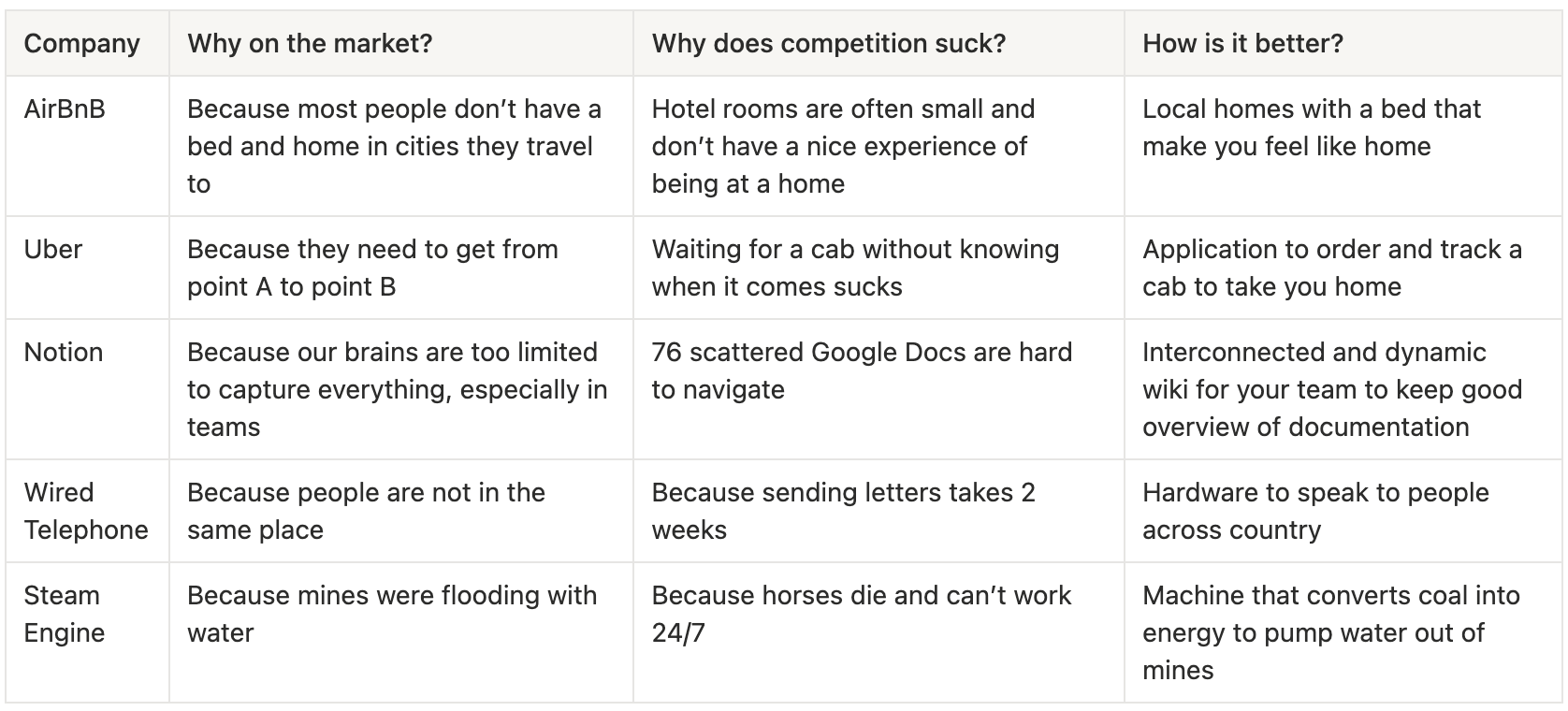
If you write down great answers to these three questions, you are building a cohesive narrative of why your startup will succeed. At some point, it should feel logical that they will buy you. That is what product-market fit is all about: the arguments should fit each other like a glove.
Stress test your product-market fit
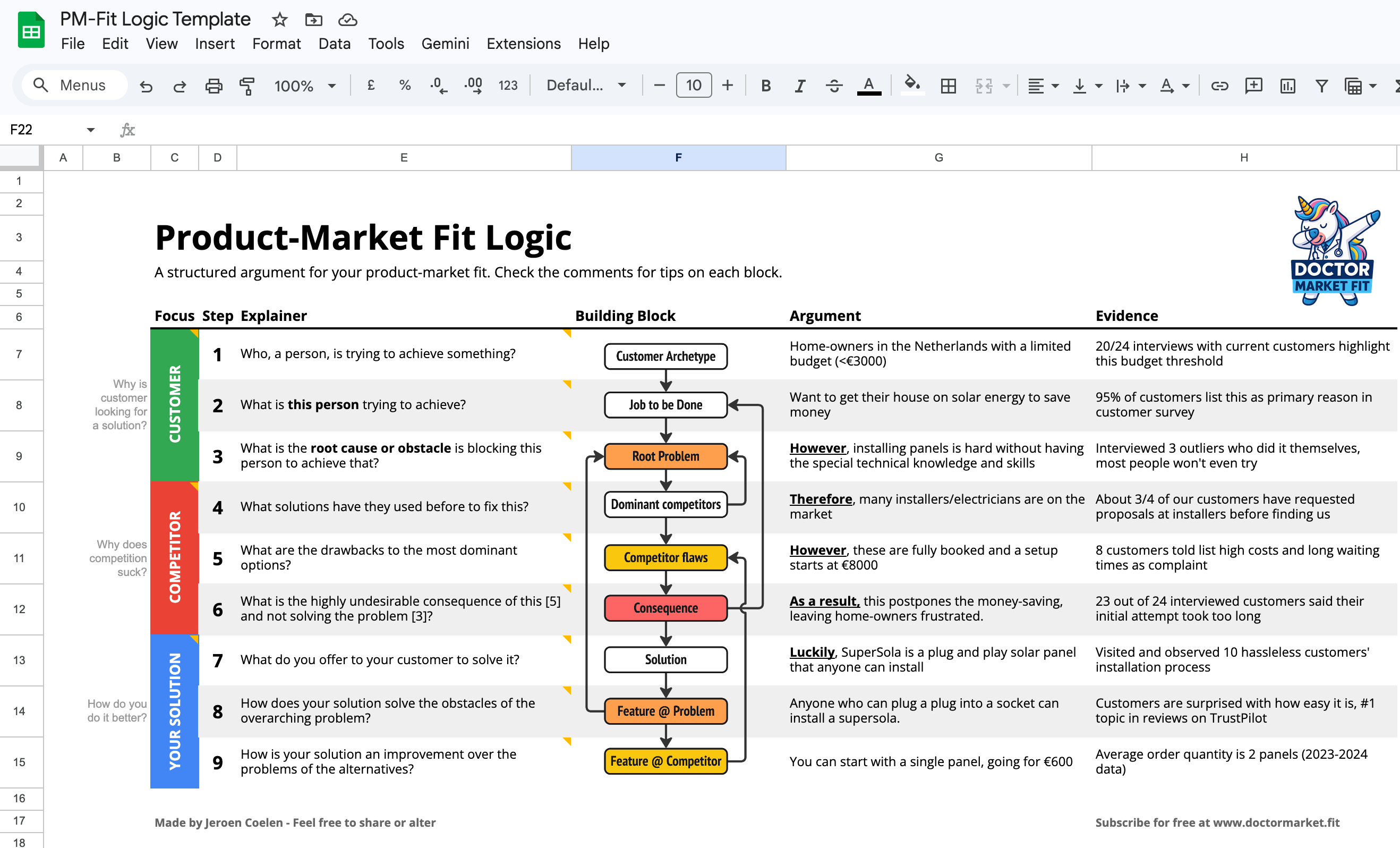
By building such a narrative, you can stress test your product-market fit easily. Based on many workshops I’ve done, this is harder than it seems. Try out this free template, the Product-Marekt Fit Logic.
🔥 Patron Content 🔥
Premium subscribers have access to a custom GPT that has been fed all my writings on product-market fit. It scores your input on all building blocks:


such a simple test, but most founders fail it