Whether you call it a target segment, beachhead, or ICP, I don’t care—growing in five of them is next to impossible. So common startup advice says you need to find focus: pick one segment and grow there.
You’ve heard it. I’ve shouted it from the rooftops for years. Everyone agrees. However, I see a significant portion of founders struggle with selecting one.
Focus picked on a whiteboard lasts about three days
It often starts here: you have an MVP that is done or almost done, or even a handful of users/customers using it. Now you say to yourself: we need to grow.
So you make a list of potential segments. You understand the idea of having a 3-wave strategy, and you end up with several candidates for wave one. I’ve seen startups that have 9.
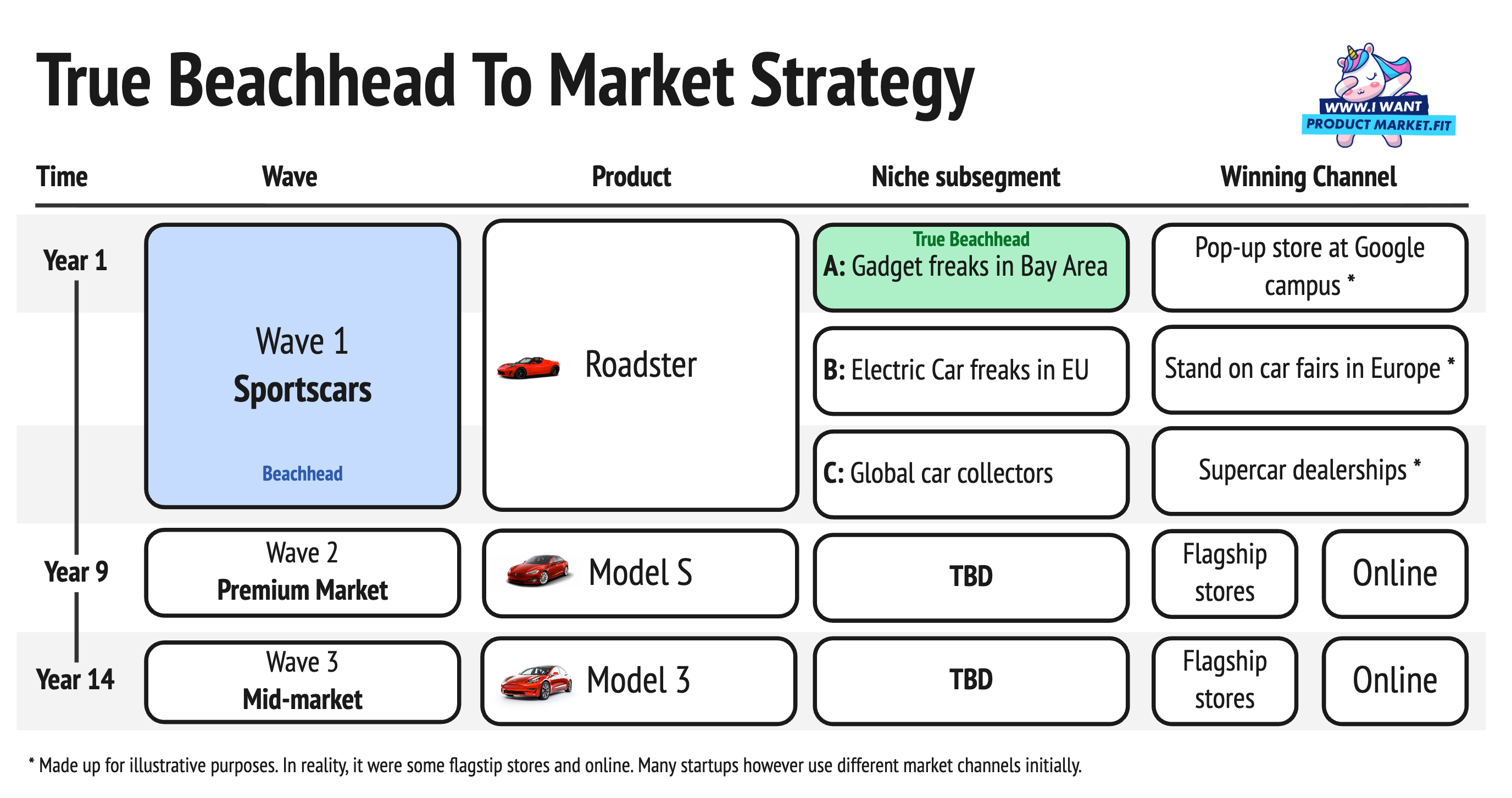
After a long discussion, you and your team select segment B, electric car freaks in Europe. The team is relieved; after weeks of chaos, you have focus. You are thinking about drafting up plans to conquer Europe. But then, something annoying happens.
The next day, your co-founder says: ‘I still am thinking about segment A, the gadget freaks in the Bay Area. They have a lot of money, you know.’
Then, your first couple of messages to electric car freaks don’t really move the needle, and three days later you’re back to the whiteboard revisiting the list.
This unfolding is what I call forced focus. It never works. Here’s why.
You can’t focus before you have data
Startups fail to choose because they don’t have very strong arguments to make the decision. You don’t have 50 customers, of which 40 are in one segment. That would make life easy.
But that soon becomes a Catch-22: You need customers to pick a segment, and you need a segment to get customers.
It’s true that sometimes you can eliminate certain segments by pure reasoning. You can just say: this is likely wave 2 (Tesla example), we need a new product for that, so we wait. That costs you nothing, so do it first. But how to decide between niche subsegment A, B and C?
It’s almost impossible without data, and most founders don’t realise this. Instead of going out there to get the data that helps the decision, they end up in front of the whiteboard suffering from analysis paralysis: should we target A, B, or C?
Get data on three segments to pick one
Most startups I get involved with have this issue. A recent AI startup I helped could sell to HR managers, Senior Devs, and they even had a proposition for CFOs. I always say, if the segments on paper make sense: try them all.
Yes, I know I just told you that you can’t have multiple segments. Attacking three segments for a week (or two) is how you find the one. You are not marrying anything yet. Targeting a segment in early-stage startups is a two-way door.
I advised starting in all 3, shooting for high-volume potential customer touches for a week (or two). I don’t care which channel—LinkedIn DMs, cold calling, going to the place where your customers hang out—as long as you hit 100+ touches per segment. Tips on finding channels here.
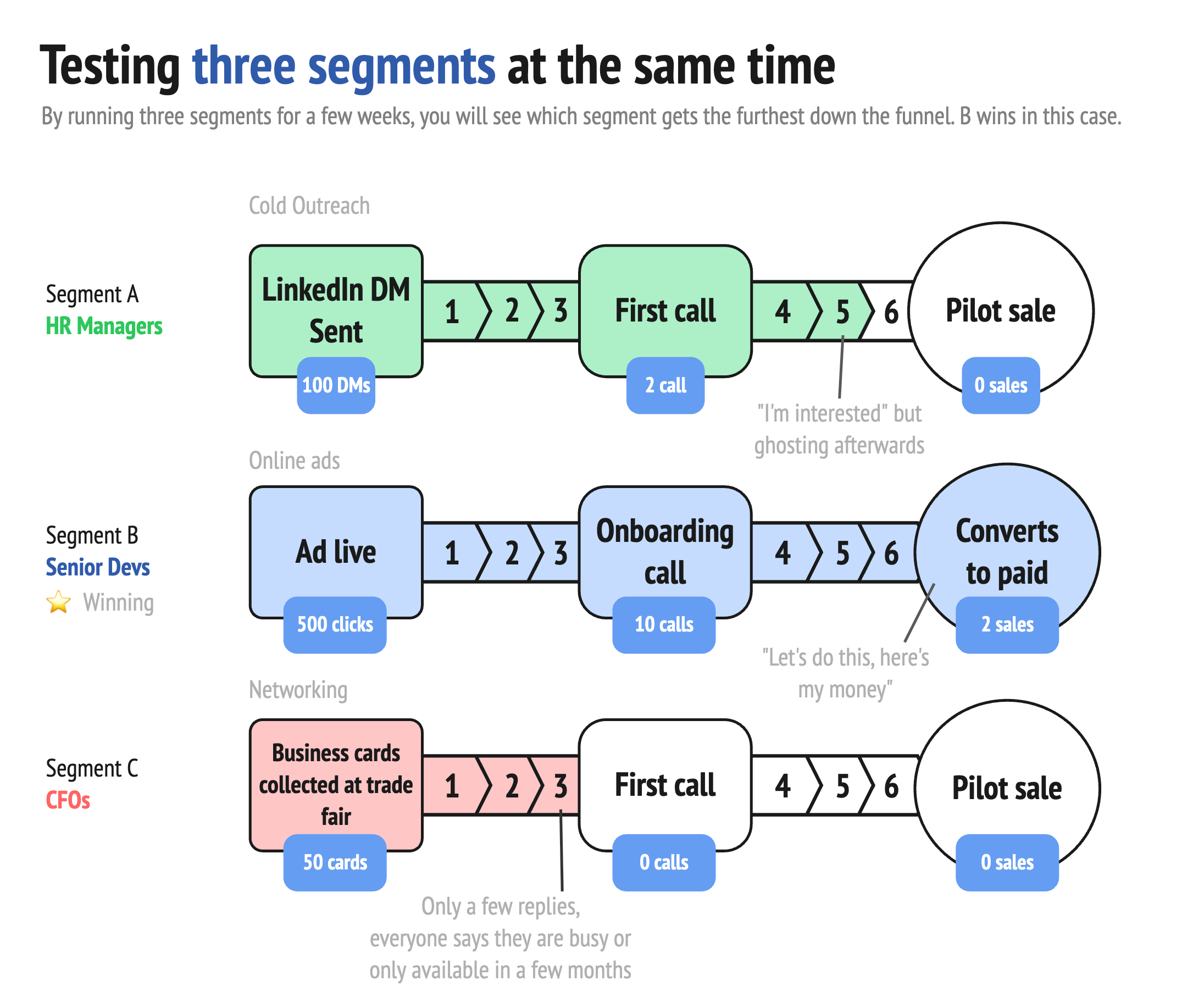
In this case, the Senior Dev segment had the most calls and conversions to paid. HR Managers responded, but ghosted after the calls and follow-ups. CFOs couldn’t be bothered. The winner clearly was Senior Devs, as they had more PULL than the CFOs and the HR Managers. The startup found something that worked.
You often know before the first sale
Quite often, you will find that one segment becomes a winner even before closing a deal. Almost always, within a few days, the founders start to feel a difference in PULL depending on the segment.
Which people are moving through your funnel most easily?
Which type of people have the best conversion rate on outreach?
Who pulls the product out of your hands during the demo?
Trust your gut here. You will feel it. Back it up with numbers if you can, but don’t wait for them: your gut needs far fewer data points to be right than a stat needs to mean anything.
Just be honest with yourself. ‘This looks really cool’ is not PULL. It’s a compliment, because they don’t want to offend you.
Now commit, for now
After that week, pick the winner and drop the rest FOR NOW. You found something that kinda works for your solution. Now get that to 10 customers, hopefully to find one HELL YES! customer (video).
Those other segments might still be valuable for the future. Your current segment will teach you about product-market fit and give you a language for the value you generate, which might help you win those deprioritised segments later.
This is just a TEMPORARY focus for you to increase your momentum and learning speed. It might be that the CFOs are your wave 2. And once you can mention twenty hell yes customers in an email, they might hop on a call after all.
Next step: describe your segment so it predicts a sale
“Senior Devs at B2B, 50 employees, 10M+ per year” won’t predict a sale, because demographics aren’t why people buy. Finding the description that does is what the Market Fit Canvas is for. Anthony Pierri’s positioning framework helps too.
Having very precise descriptions of your segment helps your targeting, which helps you to increase the volume of your pipeline. And then, you can start growing.
To grow big, you need to find your beachhead, which might seem small. That’s the whole point.
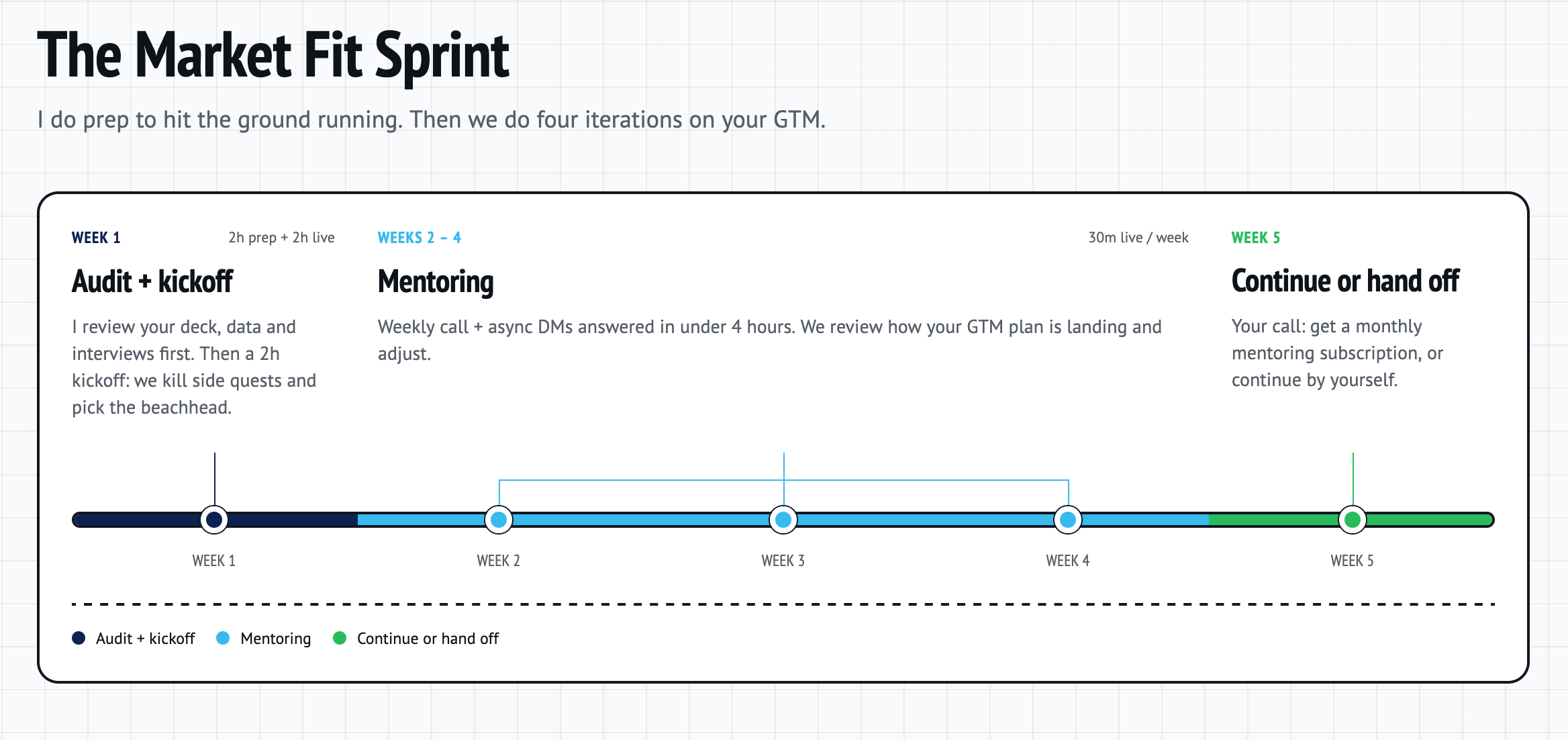
Increase your momentum with a Market Fit Sprint!
Is your startups momentum not where it should be? Are your GTM motions not moving the needle as you hoped? With a critical review of your current GTM and PMF and 1-on-1 mentoring, I will help you with exactly that.