

Job-to-be-done is a powerful framework, but most people miss one thing: many JTBDs emerge in a single task. Which one is relevant for your startup? Let’s use an example. I go to the hardware store.
I buy an 8mm drill bit. Why? Because I need an 8mm hole. Is that my full desire? Well, probably not. Otherwise, you would find the walls in my home full of 8mm holes.
I’m crazy, but not that deranged.
JTBD teaches us to ask: Why do I want that hole? I want it because I want to put in a plug + screw. But that’s not my full desire either. Otherwise, my home’s walls would be filled with screws.
Asking why is not the point
JTBD teaches us to ask why, again. And you can go on forever, asking why, finding a dozen JTBDs:
8mm hole
Plug in wall
Screw in wall
Hang painting on wall
Enjoy my living room more
Unwind after a long day of work
Relax and recharge for the next day
Make sure I get the most out of my week
Make sure I hit my targets for the month
Realise my ideal self
And then you wonder: which JTBD should be the focus for that 8mm drill bit?
The challenge with the JTBD framework is not to ask why endlessly, because you will always end up with “realising your ideal self”. (Thanks Alan Klement for pointing me towards this.)
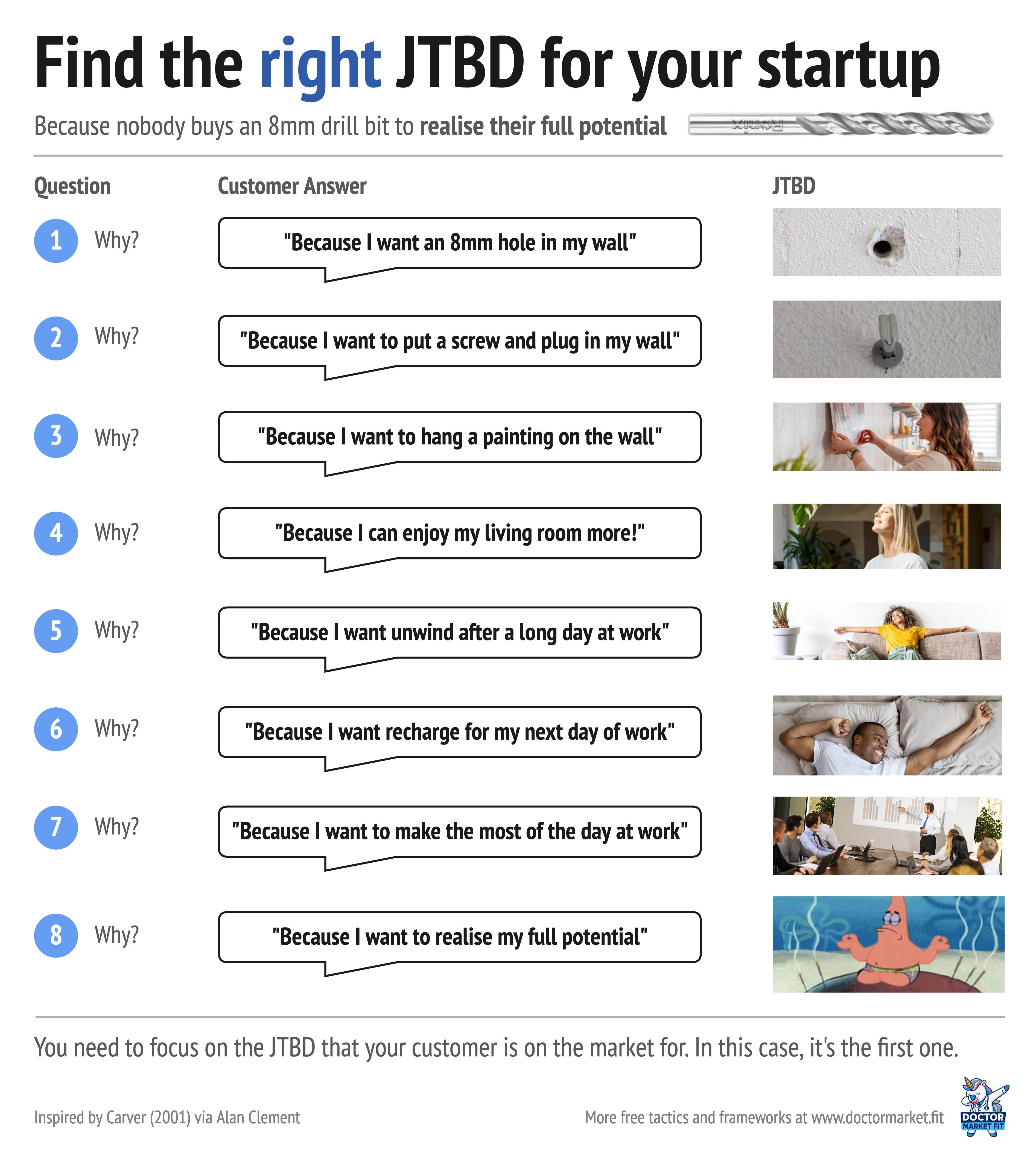
The real challenge: what are they on the market for?
The challenge is to figure out which JTBD the customer is directly in the market for (Rob Snyder‘s “Project” from PULL). All these JTBDs contribute to a purchase, but not with equal strength.
You can figure this out by asking: will your customer hold you accountable for this JTBD?
Does the bit make an 8mm hole? Sure.
Does the 8mm bit help tie the room together with a painting? No.
Does the 8mm drill bit help me unwind after work? Hell no.
The 8mm drill bit contributes strongly to the 8mm hole, more weakly to hanging a painting, and only very weakly to unwinding after work. So in your GTM strategy, the weak JTBDs don’t move the needle in your segmentation, category positioning, and messaging. (Thanks Anthony for your masterclass.)
Sanity check with marketing message
You can also test this by checking which marketing message sounds reasonable. With this 8mm drill bit...
Now you can create a hole in the wall: Sure
Now you can unwind after work: Dude?
Now you can realise your ideal self: WTF?!
The JTBD exercise is helpful because it shows you the bigger picture (what Ash Maurya calls “the next summit”). It also gives you the ingredients to judge which JTBD is relevant for your startup.
So the task is not to ask why endlessly. The real challenge is finding the right level in the hierarchy for your JTBD.
Dit inzicht leverde wel de betere Hornbach-reclames op, denk ik