

Last week, I was mentoring a recruitment startup that was trying to tackle a latent problem.
The idea: There are many active-looking people on the job market who go to job boards. But some people are latent, as he told me: not looking, but maybe open. Isn’t that an opportunity?
Before building anything big, he’s concierge-testing this (some call it handcrafting). Do things that don’t scale!
When he approaches potential customers via LinkedIn, he talks with them about their job. Aiming to surface their frustration, with for instance, their boss, or their long commute.
Even though they weren’t actively applying to jobs, all of a sudden, they are open to a new job. That is a latent problem, then, right?
The recruitment founder thought we were onto something, that there is a vast group of people that you can activate in this way: a latent problem beachhead market. What if you can unlock that? Shift the industry? Well.
However, the more outreach he did, the fewer conversions he made. Was this latent problem really a latent problem? It prompted me to reflect.
Problems in general
I see problems like this more often. Sustainability startups that work on the latent problem of “People want to be more sustainable, but don’t act on it” — dime in a dozen of those. Is my idea of latent problems perhaps wrong?
Below is one of my favourite frameworks, which helps to recognise high-urgency problems.
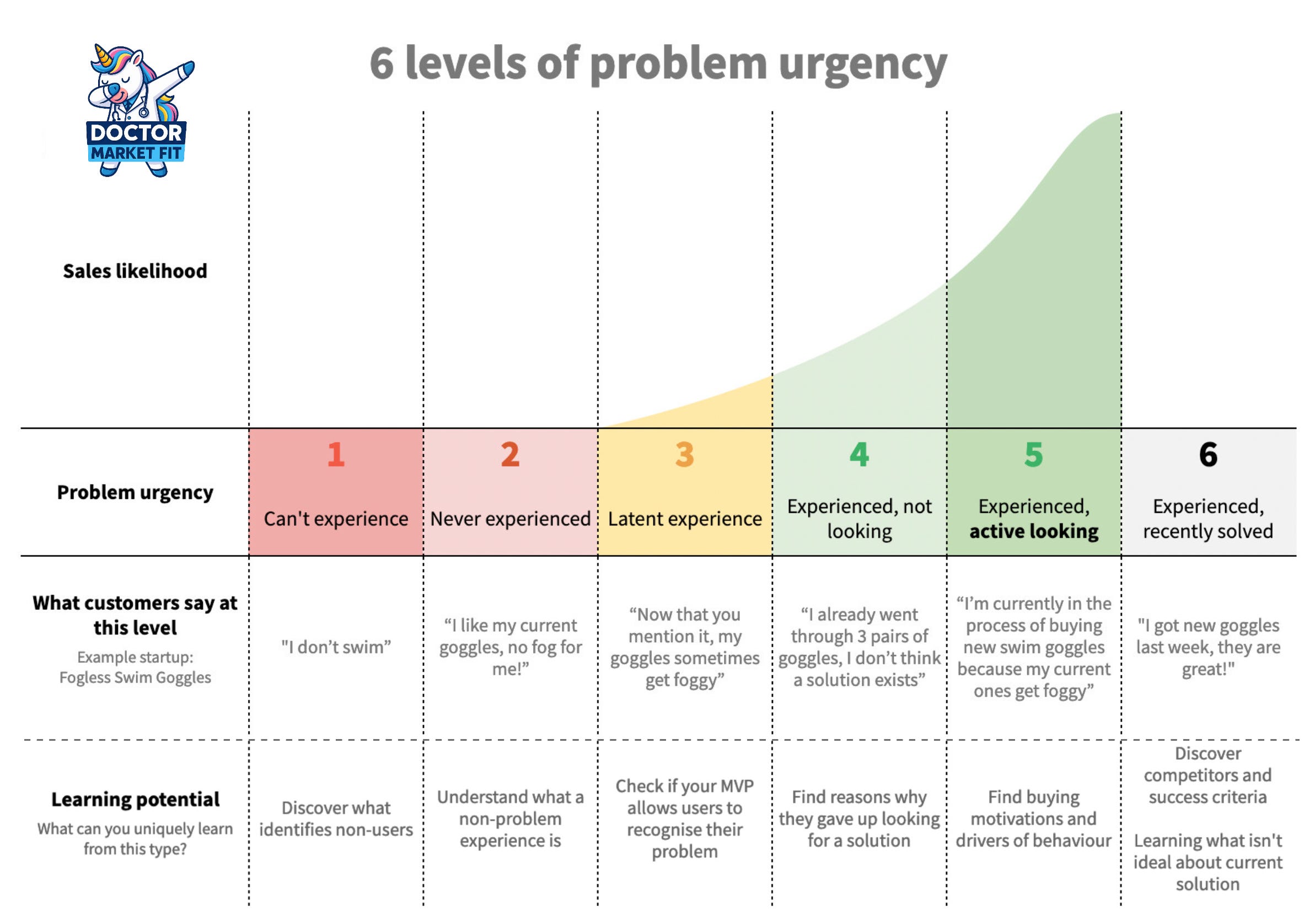
On the lower levels of problem urgency, 1 & 2, you find people who can’t or don’t experience the problem you are aiming to solve. You can’t sell to them.
On the higher levels, 4 & 5, we find people who are open and on the market for a solution. Sales potential grows. At level 6, you missed the window to sell.
At level 3, I put the latent problem, based on a suggestion of a mentor to whom I showed the initial version of this framework.
“How could I’ve missed latent problems, I thought?”
I thanked him for the tip and published it, including latent problems.
But in this experience, I’ve learned something new that adds additional nuance.
Do you need a sanity check on your go-to-market strategy and your product-market fit? Work with me 1-on-1. First call is always free. More info here.

Latent problems don’t exist to the customer
The idea of latent problems, according to the textbook, are problems that are not yet recognised by the main stakeholder.
In the case of startups, that stakeholder is the potential customer. I add ‘potential’ on purpose, because customers are people who actually give you money.
However, there’s a paradox: you can’t talk about latent problems.

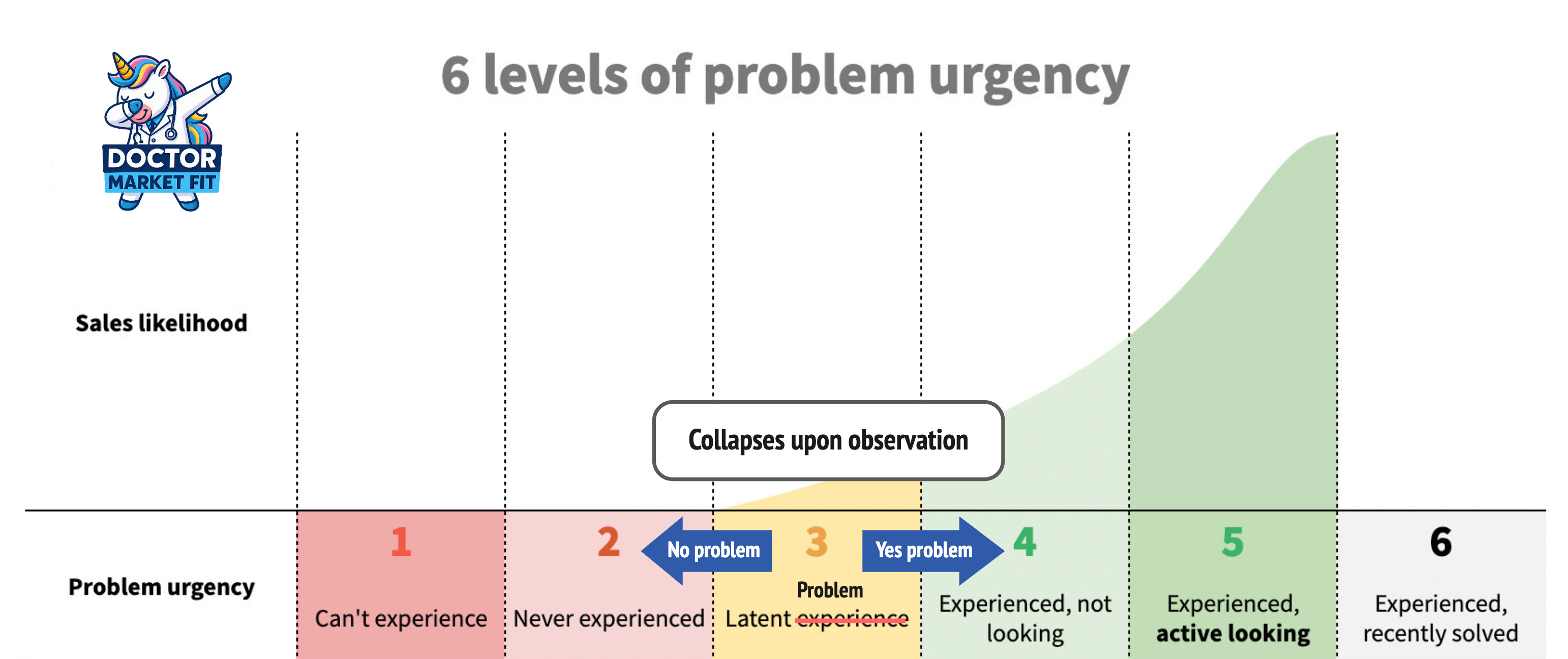
The moment you talk about an unrecognised problem, it stops being latent. You made someone aware, hence it loses the status of being under the radar, by definition.
The experience and act of observing the problem changes the problem exists. To make this clear, let’s make an analogy to quantum physics.
Schrödingers cat
Remember Schrödingers cat, a thought experiment on the concept of superposition of quantum mechanics?
When I asked the recruitment founder this question, he started laughing: “Why do you think I know anything about quantum physics, Jeroen?”. Okay, fair.
You put a cat in a closed box with poison that is triggered by a single radioactive atom. If the atom decays, the poison is released, and the cat dies. Poor kitty.
According to quantum mechanics, until the atom is measured, it is in a state of being both decayed and not decayed. Therefore, before you look in the box, the cat is entangled with the atom and must be considered both dead and alive (superposition).
The moment you look, the superposition collapses into one reality. You either see a dead or a live cat. Cats can’t be dead and alive at the same time.
Schrödinger created this scenario to demonstrate how absurd it creates situations when quantum rules are applied to everyday objects.
Schrödingers problem
Now, the sudden collapse of the cat’s vitality into alive or unalive upon inspection sounded familiar. For unrecognised problems, it seems that observation collapses the latent position of a problem.

When potential customers are made aware of a problem, they can either recognise it as a problem or not.
If they don’t see it as a problem, they ignore it, so you can’t make a sale.
And even if they see it as problematic, they have two options. They can still see it as not urgent, i.e. the potential of chewing gum under your shoe is not something we proactively try to avoid.
In some cases, the potential customer will say: ‘Wait, was I being inefficient? I didn’t know! Is this a thing I can do faster?’ Then they might buy.
What did the founder do with his latent problem?
After I showed the founder the draft of this article, he added an interesting challenge:
“How do you test if somebody is actually in 4 or 5, and not a 3? They often don’t know themselves.”
Sometimes, you start with somebody being a 3. But then, in the conversation, they flip to a 4 or 5: yes, now that you say it, please help me.
But sometimes, he reflects, there’s doubt. He finds that if he pushes them (a thing he doesn’t like to do), you can get a fraction of them in your sales funnel. It takes a lot of effort, but you can do it.
He goes that, of that small fraction that you can get into your funnel, an even smaller fraction converts to a sale. So the majority of those hard to convert ones actually is just a 2 disguised as a 4. Real 3s don’t exist.
He reflects that the best way to find out if you have a 4 or a 5, or a hidden 2, is:
“Just ask very directly if they want to buy you. Make your proposition, and see if they want to buy”
That usually filters itself. Don’t convince people who are not ‘desperate’ to buy you. You need high problem urgency.
Don’t chase latent problems
Therefore, if you recognise your startup is built on a latent problem, you are in a risky territory. It’s not just a weak problem; in many cases, it turns out not to be a problem at all. Schedule a call with me for a sanity check.
Related reading
The difference between problems and jobs to be done (article)
How to spot the right job to be done for your problem (video)