

The most underrated thing to do as a pre-product or pre-launch founder is to think about the following:
How can I shorten my time to market?
That means, how can I get to sales or paid pilots as soon as possible? Often, people build an MVP for this. That is a great move in itself. However, the M in MVP often is not honoured: many MVPs have way too many features.
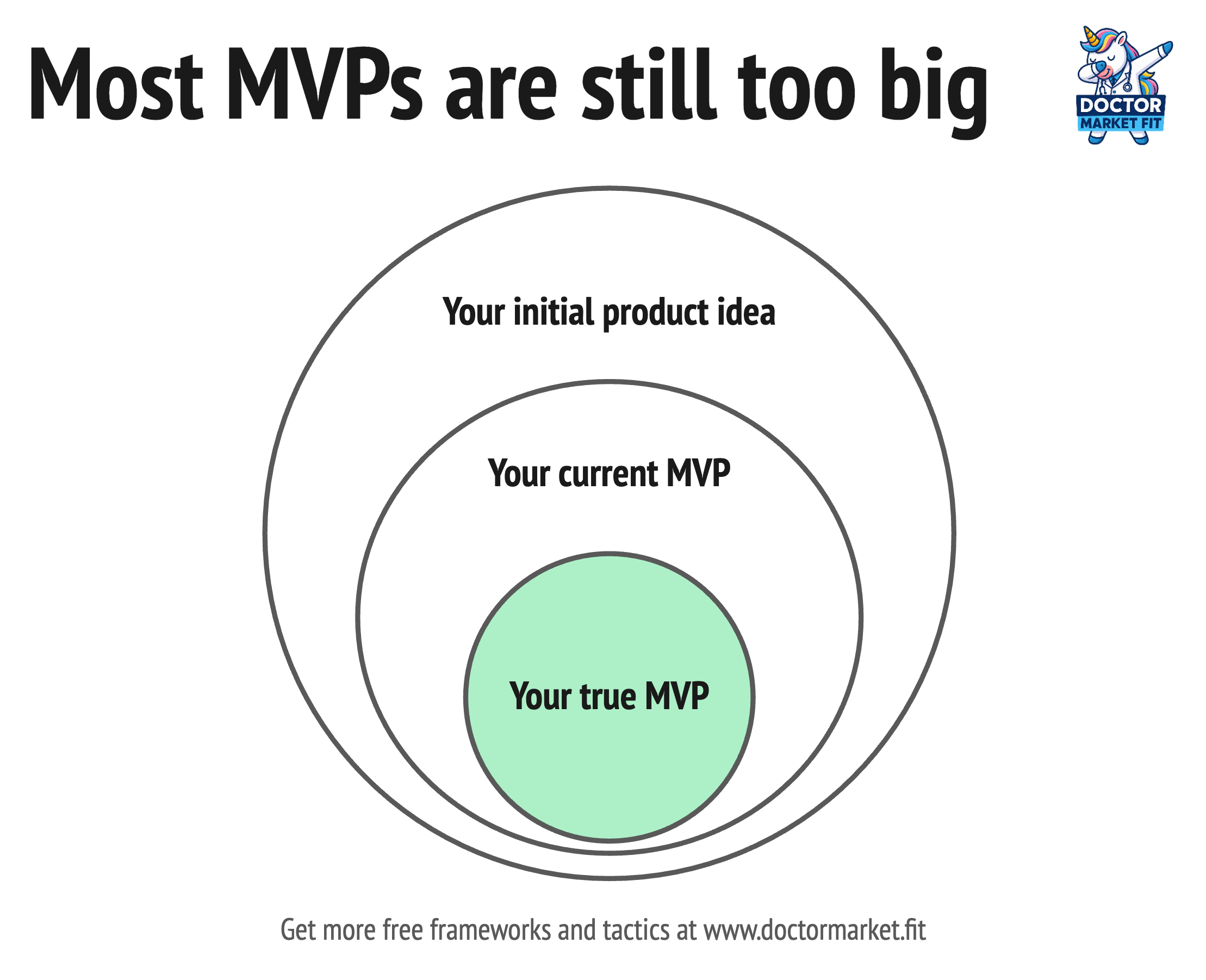
I see two reasons for this:
Too many features are considered the core
The beachhead segment is so broad that you need many features to satisfy all of them
I’ve written many posts (here, here, here, or this one) on defining your true beachhead segment. Still, a narrow beachhead doesn’t solve all problems. How do you go from a narrow beachhead to an MVP?
Identify true key features with MoSCoW framework
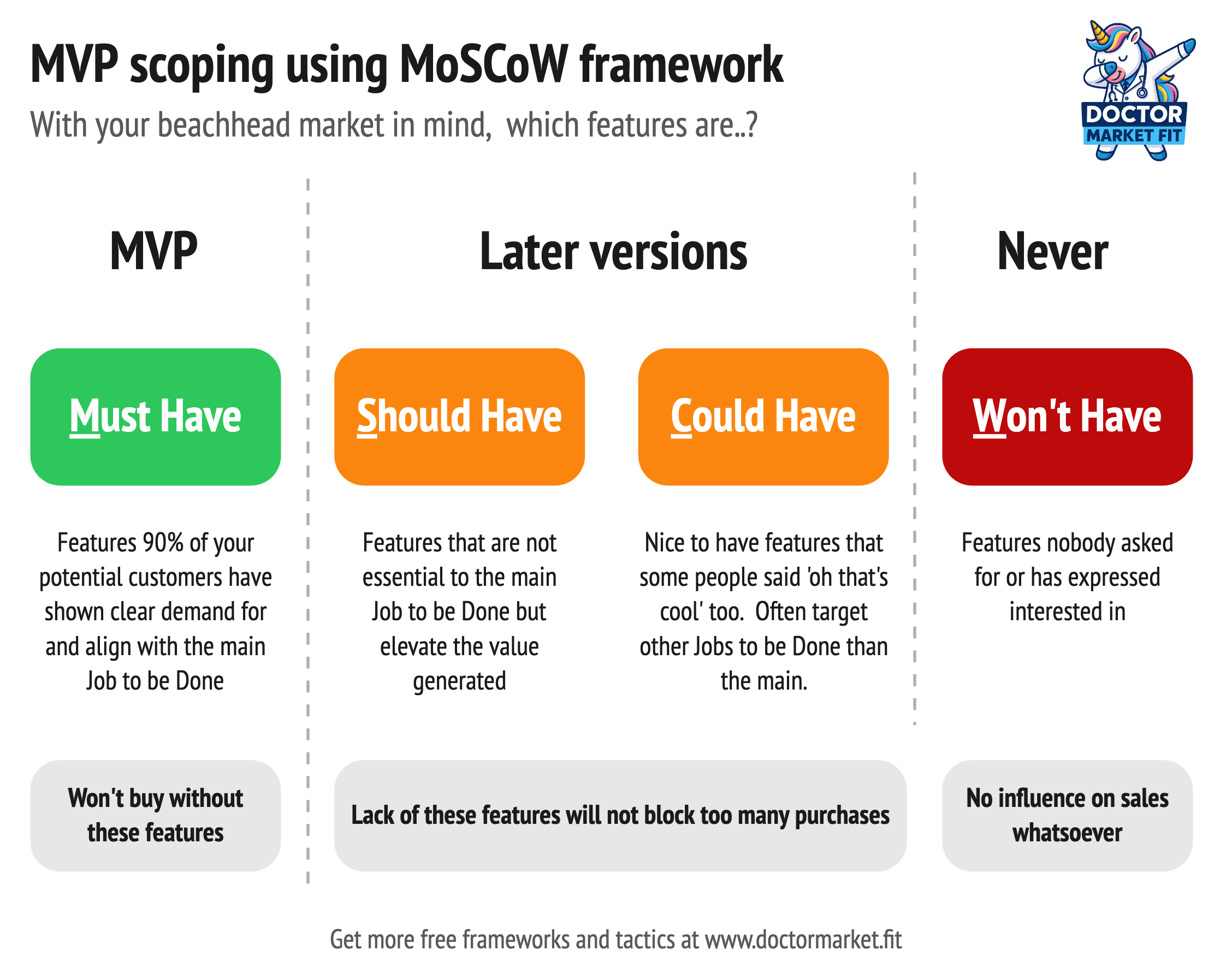
The MoSCoW framework, developed in 1994 by Dai Clegg, asks four questions:
What features MUST my first version have?
What features SHOULD my first version have?
What features COULD my first version have?
What features WON’T my first version have?
Are your founders’ beachhead markets too vague or broad? Are they building instead of talking to potential customers? I run two hands-on workshops for accelerator programs that fix these issues.
In answering these questions, you need to go through your mental or actual database of insights from sales calls and problem interviews.
Must Have:
Features that 90% of your beachhead needs
Essential to addressing the main Job to be Done
Hair on fire problem stuff
Won’t buy you without this
Conclusion:
Don’t skip this
Make sure you have the data to support it—‘5 people said they were interested’ is not strong data
Should Have
Features that generate value but don’t serve the main Job to be Done
60% of customers would seriously benefit from this, but can still generate enough value without it
Conclusion:
Include these in the later releases
But don’t add before your Must-Haves work greatly
Could Have
Cool ideas that do not add to the main job to be done
About 25% of customers could seriously benefit from it, and future features built on this might unlock a new segment.
Conclusion
Postpone for now, unless you are ready to double down on that new segment.
Won’t Have
Feature ideas that will never help more than 5% of your target market
Features aimed at completely unrelated jobs to be done
Often are the result of creative brainstorm sessions or strong opinions expressed by 1 potential customer
Conclusion
To hell with it
Kill it with fire
Common challenges with this framework
Problem: “Just 2 features feel too small to generate value”
Solution: That’s an assumption; make sure it’s true: pitch these two features before building anything with a brochure test. 10 pitches, and you know if you are on the right path.
Problem: Some founders have limited market input; therefore, they are reasoning about which features might help their customers, rather than basing it on actual expressed interest/sales.
Solution: go out on the market, do 20-50 sales calls (even pre-launch) to see which aspects resonate the most.
Problem: The beachhead market is too broad (all SMEs with $10M+ revenue). Your beachhead should be rooted in behaviour, not firmographics.
Solution: If you can’t answer the first 6 out of 9 questions (use this tool to verify), you need to talk to more people.
Problem: I’ve got three features that 3 different groups of people like, not one that covers 90%
Solution: Your beachhead is too broad; you are targeting too many people. Unless you are launching in an inherently multi-stakeholder environment that needs all three from the start, you might want to pick one of the three to start out with.
Do you want a 1-1 session with me? I’ve got three mentoring slots available
🔥 Extra Practical Examples 🔥
Whenever I run this with a startup, the above issues pop up. 95% of founders that can’t answer these questions with evidence just need to go to the market more often.
I mentored this construction startup that was very early stage. It was a new material technology that performed higher on sustainability aspects. However,
