

Last week I was having a coffee with a founder who runs a recruiting-AI startup. Early 20s, already doing six figures in the recruiting business he’d built before he ever launched something with AI. Now he’s automated parts of that process internally and is aiming to sell that solution. He was booking the calls just fine. He wasn’t closing them.
We’d already ruled out the obvious stuff. He had a deck. He’d learned not to demo everything in the first ten minutes. He’d even started asking prospects what they currently used before he pitched anything, which is more restraint than most 23-year-olds have in them. None of it had moved the number, so something else was broken.
Revealing the order of a call
To find out what went wrong, we role-played it, right there at the table, me playing his client while my coffee went lukewarm.
“Hi, thanks for taking the time to meet me,” he said, suppressing a laugh, as we were getting into our roles.
I told him, with a suppressed grin, that I used Greenhouse — a popular tool for automating recruiting busywork — because I had a stack of job openings to fill with way too many applications to handle.
He said that it has AI screening built in. I said, yeah, and I told him I tried it, but it didn’t work well: the results were bad, and it made me anxious about whether I missed any good candidates in the automated AI filtering.
I then said I stopped using the AI screening, and it actually was fine like that. He nodded.
Then, he jumped straight to pitching his own AI screening feature: “Would you like to have this overview that explains why we have selected certain candidates?”
Like a director saying ‘Cut!’, I stopped him right in his tracks. The timing couldn’t have been better, as I was at my limit of improvising a conversation about a tool I didn’t use.
The primary goal of the sales call is not to get a ‘yes’
Many founders who struggle with sales chase a yes on whatever they build. So the moment a prospect mentions anything that (vaguely) resembles the need or problem, they jump straight to the pitch. If done badly, the potential customer is bombarded with five features in a ten-minute monologue, hoping they will say yes to one of them.
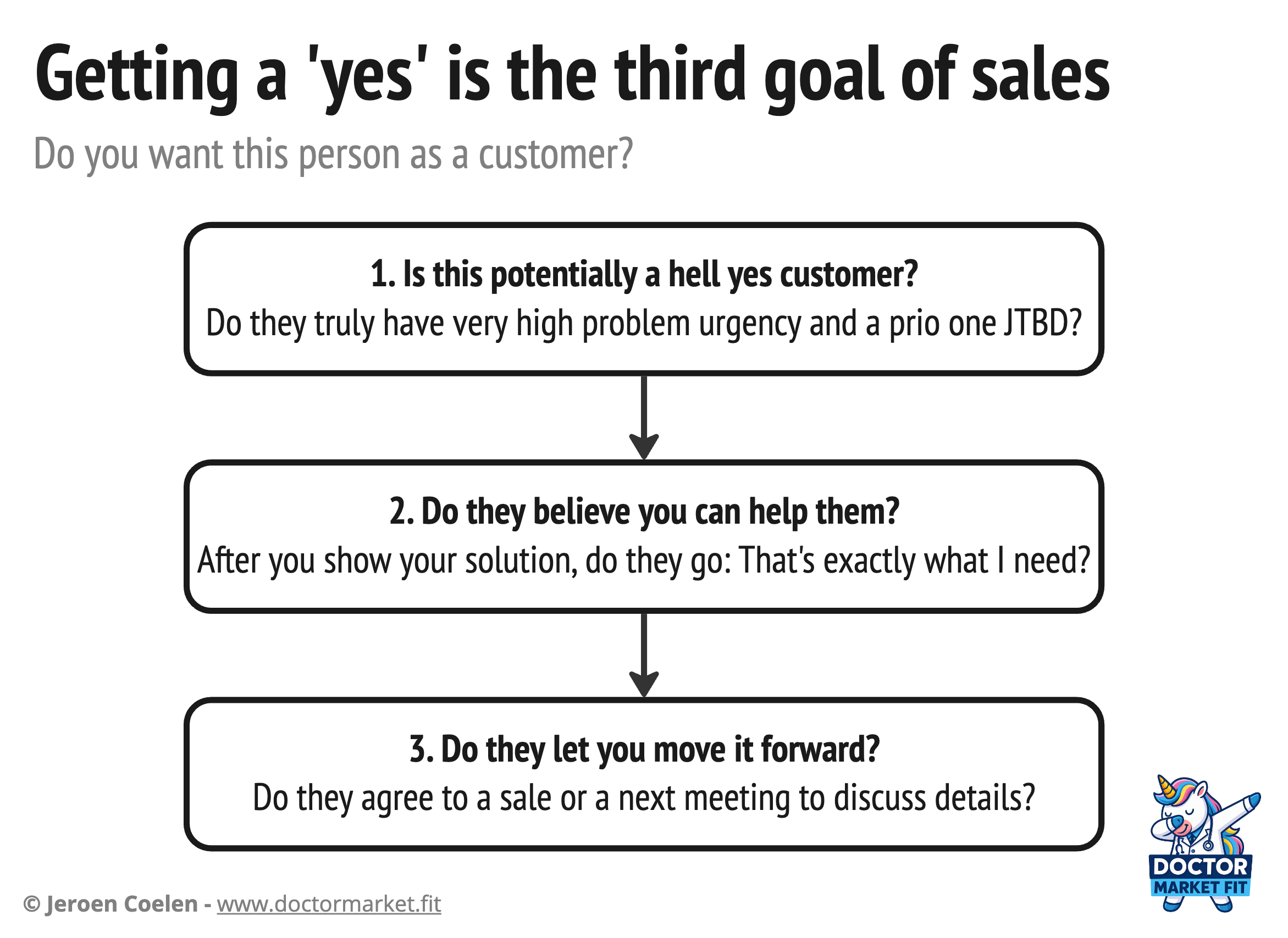
That’s the shift he needed: a sales call does not have the primary goal of the client saying yes to whatever you build. That is the third goal. The order goes:
Qualify whether you should even pitch your solution: Do you want this person as a customer? Is this potentially a hell yes customer?
If the first one is yes, the second goal is to find out if your client wants your solution, e.g. they say “That’s exactly what I need!”
If all goes well, the third goal is that this person says yes to moving things forward. Not necessarily a yes to a sale. Just a yes to keep talking.
A penny drops
Back to the roleplay. Being pretty sure that his intentions were misaligned, I asked him what his goal for the call actually was. He didn’t answer right away; he just sat there for a second, thinking, while I poured myself some more water. Then: “I want to sell!”
“But do you want to sell to a client that doesn’t need you?”
“No, of course not!”
“How do you know then if this client needs you? I told you I was fine without the AI screening.”
Again, he let it sink in.
You don’t want all prospects to convert
The first question is counterintuitive. Do you want this person as a customer? Of course, you want as many customers as possible, right? NO! Some people you don’t want as customers. You want people that you can make happy (hell yes customers). You can’t make people happy who:
Don’t care about the problem you solve
Don’t have the need/JTBD to improve on the thing your solution does great
Have a solution that is good enough for them
Are extremely reluctant to change and try new things
Are mega cheapskates who complain about your price a lot because they don’t see the value you bring
Thus, a sales call is mostly to qualify what this person needs, and whether you are the right solution for them.
Therefore, the conclusion of some sales calls might be: “Did you know that Greenhouse already has built-in AI screening? It’s not as good as ours, but for low-volume work like yours, that should just do it. Our solution is overkill for you.”
Then, this person is happy because you helped them, and in the future, if volume goes up, they might think of you as this nice guy who has the best intentions for them; ping them in 3 months to check if anything changed.
Resisting the pitch
When we picked the roleplay back up, I could see him struggle. He was resisting pitching his solution, but grasping at straws. Then, he blurted out: “What should I ask instead?”
“Well, you know I use Greenhouse, and I’ve even mentioned a limitation. Why don’t you ask what I think about that limitation? Ask ‘Why is that annoying?’ a couple of times.”
Then, something clicked. He was a different person on the call. He started asking real questions instead of listing his features.
“Why is that annoying?”
“What’s actually stopping you from fixing it?”
“Have you looked into other options for AI screening? Why not?”
He was now asking questions that helped him understand whether the person in front of him would actually be a good customer for him. The roleplay genuinely helped to surface the issue.
He got immediate results
He had another call two hours after ours. I texted him the next day to ask how it went, half expecting to hear that the AI screening feature had landed.
It went fine, he said, but the AI screening feature he interrogated me about for twenty minutes turned out to be a total non-issue. The real problem was something he’d never even mentioned to me: automatic follow-up. He only found that out because he’d finally started asking instead of pitching.
Conclusion: the pitch can wait
You can’t fix a problem that isn’t present in the customer’s life. Rule one of sales calls is that your customer must articulate the problem or JTBD you can help with. The goal is to get them to say it, or find out it doesn’t manifest in their life. Only then do you pitch and see if the client says, “Shut up and take my money.”
The recruiting founder's situation tracks with something I see constantly: the person who built the manual process is often the worst salesperson for the automated version of it, because they keep explaining the mechanism instead of the outcome. He knows exactly how the automation works, so he pitches the how. The buyer just wants to know if their problem goes away. Did the fix end up being about stripping the technical explanation out of the call entirely?