

Over the past few months, outreach guru Prateek has helped me improve my outbound
I went from zero outbound to 28% reply rate on LinkedIn
And 13% of them book a call with me.
Here’s what Prateek taught me

1. You gotta propose yourself
Regardless of your reach, you need to put yourself out there. I have over 10,000 followers on LinkedIn and 5,500 on Substack. But the moment you don’t say, “Hey, this is how I can help you,” they will not respond. Ninety-nine per cent of people need an explicit offer to react to you, and you need to create that trigger.
In my early days of my LinkedIn and Substack journey, I didn’t explicitly include a call to action, saying, “Hey, if you are dealing with a problem around product-market fit, here’s where you can find me.” I forgot to add it in the first two years, which is dumb, but you need to do that.
Make it easy to buy you (or to say no)

2. Talk about yourself, not them
A mistake I made is that most outreach guides say you need to talk about them, saying, “Oh, you have this problem.” You don’t need to do that. If people have a problem, they know it. You don’t need to educate them on the problem that they have. If they are highly urgent buyers, you should talk about yourself, and this is counterintuitive.

Think about those infomercials where people mess up cooking an egg and say, “Don’t you hate it when an egg falls out of your skillet?” You feel disdain for this advertisement because it doesn’t treat you seriously as a buyer. “There must be a better way”. You know there must be a better way because you have been fed up with this problem for at least a couple of months.
Tell me what the better way is because I am already in pain. This is something most people do not realise. If you explain very well how you might be able to help them, people will filter themselves for you. They will filter: “This is for me,” or “No, this is not for me.” That is what you want to achieve. You want to be so crystal clear that people can tell, “This is for me.”
This is my current message that converts 28%.
Hi [name]!
I’m a mentor who has helped 350 startups in solving their market fit puzzle.
I recognise problems and potential solutions in startups quickly, and tell people what I think, no bullshit.
Founders check in with me weekly or biweekly. Here we do a sanity check on their priorities (are they missing any blind spots?) and critically question how they process market feedback.
It has helped founders to find their GTM focus, and feel more certain about the strategy taken.
Startups are fun puzzles which tickle my brain and solving them makes founders lives easier.
Let’s chat if you see a fit.
Cool right? If you actually want to chat, get in contact with me here.
3. Quality over volume is the wrong mindset
I have falsely preached that quality is more important than quantity. I thought that because this worked for me on a small scale, sometimes sending out a very carefully crafted message to some ICP converts pretty well, and it might do just that. But it doesn’t convert the best.
With Prateek’s help, I crafted that above message that I now copy, paste, and send to people. I just copy-paste the message. I never thought it would work, but right now I’m getting it in my first attempt, I’m getting a 13% meeting rate and 28% reply rate.

4. Your ICP might be right, but also limited
Based on my experience, I sell to early-stage founders. I know most people over three years in their startup are likely too close to or over product-market fit and they cannot really help them.
I used Prateek’s low-hanging fruit method, and simply, in a spreadsheet-style started to qualify who I think is my ICP. In an experiment, I reached out to a bunch of people whom I wasn’t sure were my ICP. Out of the twenty messages I sent, two of them were completely something I didn’t identify as ICP, and they said, “Yes, I want to book a call with you.”
And then I was baffled. I thought, “Huh? I would never think this ex-student of mine, because for some reason I don’t consider ex-students commercial, or I would never consider that this type of startup would consider my service.” And they say, “Yes, Jeroen, I want to talk about product-market fit”.
So, sure, you have an ICP, but also be open to the fact that you don’t fully understand who you should target.

If you want to read more about targeting and segmentation, here are some helpful reads:
5. Automation is not evil. Bad targeting is.
Every outreach expert will tell you that automation sucks, and I agree. Because what most people do with automation is set their ICP or targeting to CEOs of mid-size SMEs in the Netherlands or CTOs in Europe. That is a recipe for disaster if you automate outreach messages to that target group.
Not because automation is inherently bad, just because you’re fishing with a way too wide net. AI filters can help a little bit, but they are not perfect. I am definitely not advising to spam everyone. I once mentored a founder who said I sent 5,000 DMs and only three people responded, and they all said no. That is a sign of bad targeting, not of bad automation.
A good tool for LinkedIn automations is ReactIn, happy user myself
LinkedIn's inbox is a horrible UI. I use Kondo to manage my LinkedIn DMs.

Just don’t be cringe.

6. You have more leads in your rolodex than you think
I wrote about this before: you likely have way more leads in your rolodex than you think. In this guide, Prateek has shared how he makes sure that his clients maximise the connections they already have.
There is quite a lot of academic research on this, too. There is an idea between weak ties and strong ties. Entrepreneurs are seen, or effective entrepreneurs are seen, as people who are very capable of maximising their weak ties, and you have a lot of weak ties, my friends.
Just as I said, I had two people from a past relationship: an ex-student of mine who wanted to talk, and an ex-colleague who wanted to talk. I didn’t even know they were entrepreneurs, because my automation contacted them with a message I know now.

7. Accept that you are going to annoy some people
I’m not saying spamming is good, but with a broad outreach strategy, you are inevitably going to target people who cannot buy from you. And that is okay. Sometimes I get a reply from people that say, “Hey, thanks, I love your content, but currently I don’t need you.” So on paper, you have annoyed them with a message.
This is an inevitable aspect of doing sales. You’re going to get nos, you’re going to get objections, you’re going to get rejections, you’re going to annoy people. The main trick is not to annoy them the moment you realise they indicate you annoy them.

8. Fight ghosting with this follow-up message
Ghosting is annoying. You send a message out to people, but sometimes they don’t reply. This is fine. But you can send a reminder. How many times should you remind them? You are not going to send twenty messages, right?
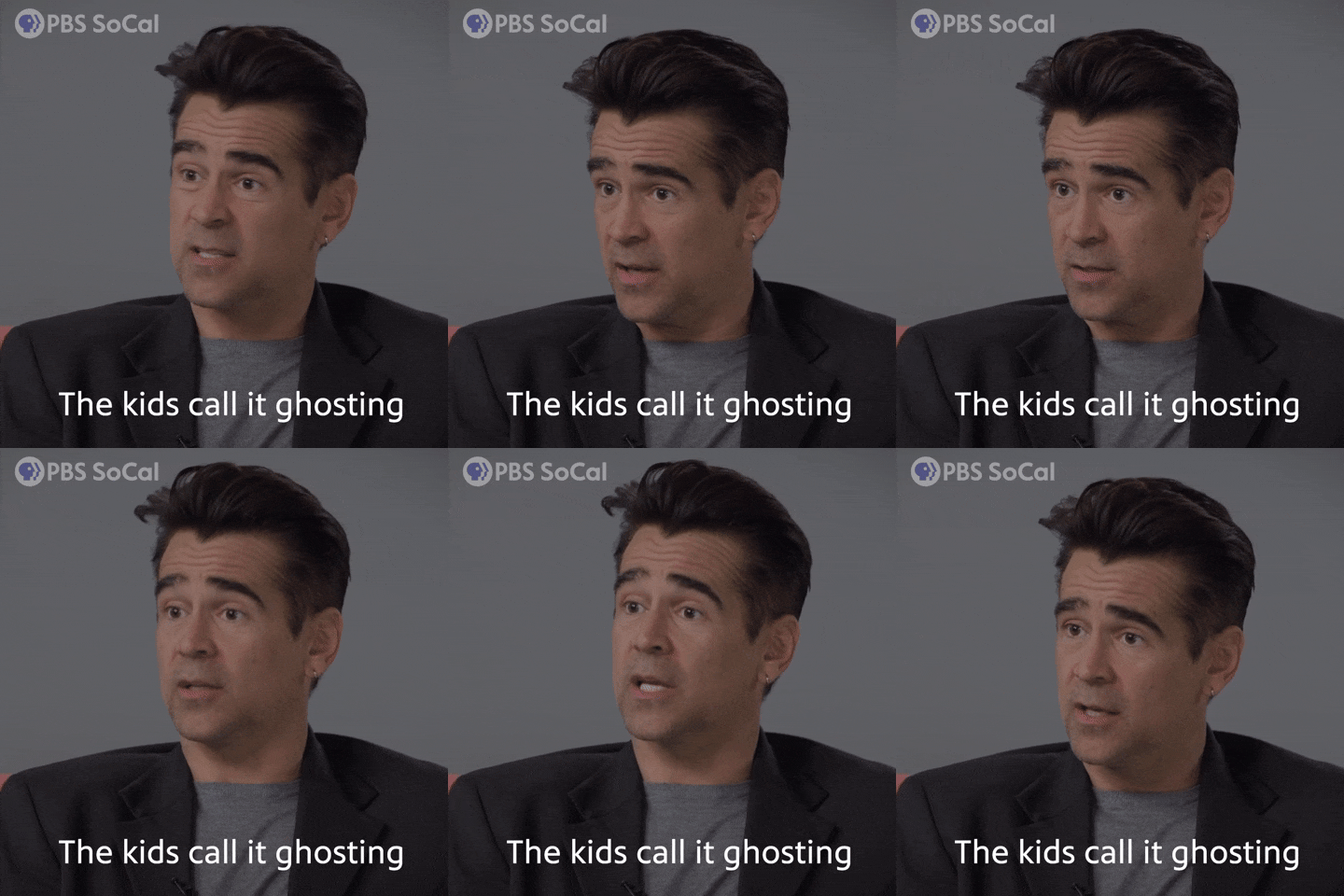
I’m not sure who gave me this tip, but it’s a golden tip on email and DM marketing. Send up to three reminders maximum. The last reminder should say something very simple, as follows:
Hey, I see you didn’t reply to my emails. I can imagine you’re busy. If you’re still interested but cannot create a full response right now, I understand. Just let me know in a very brief response, and I’ll reach out to you in a month when dust has settled.
Founders report back that they get great conversions on this. It shoots up. Some people even respond with a 20% response rate to this message type, the third reminder.
9. Need help writing outreach copy? Ask Prateek for help.
Prateek has a highly unorthodox interview process where he asks funny questions like, “Do you think your future self, 10 years from now, will be proud of the work you are doing today?” or “Has anyone ever said thank you to you? Have you made someone’s life better? What does this mean to you? Why does this matter to you?”

With the help of your answers to these questions, he can craft these unusual outreach copies that aren’t even strictly about the problem and the solution or the product and service. They also mention the human element of the business, talking about the identity, mission, and purpose of the sender.
I found it nuts to talk about my psychology or motivation in a message to a complete stranger. But the strange thing is that it actually works.
Prateek is happy to help run this interview and writing process for free to anyone who asks. It is already a part of his paid LinkedIn outreach service, but he enjoys doing this little bit just to help people out.
To get in contact with Prateek, send him a message on LinkedIn. It’s worth it. With Prateek’s help, I’ve gone from zero monthly outbound to closing 4 deals a month and a 13% meeting rate on LinkedIn.
Great tips, Jeroen, thank you.
The jury's still out on how many follow-ups you should do, though.